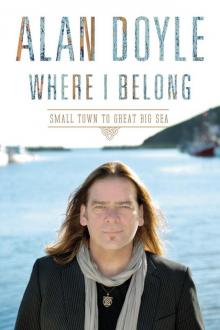
A newfoundlander in cana.., p.1
A Newfoundlander in Canada, page 1
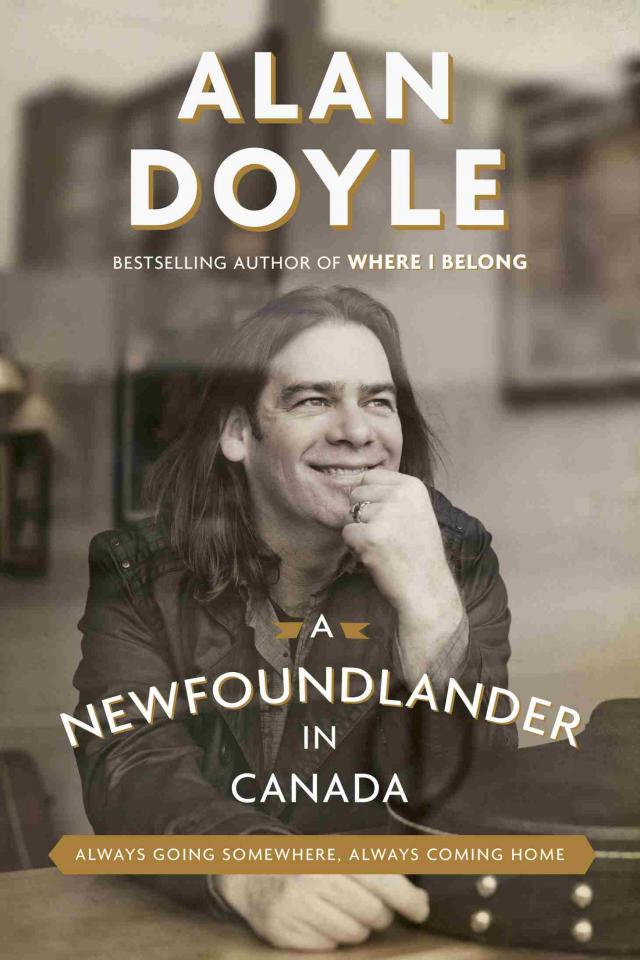


Detail left
Detail Right
Copyright © 2017 Skinner’s Hill Music, Ltd.
All rights reserved. The use of any part of this publication, reproduced, transmitted in any form or by any means electronic, mechanical, photocopying, recording or otherwise, or stored in a retrieval system without the prior written consent of the publisher—or in the case of photocopying or other reprographic copying, license from the Canadian Copyright Licensing agency—is an infringement of the copyright law.
Doubleday Canada and colophon are registered trademarks of Penguin Random House Canada Limited.
Library and Archives Canada Cataloguing in Publication
Doyle, Alan, 1969-, author
A Newfoundlander in Canada / Alan Doyle.
Issued in print and electronic formats.
ISBN 9780385686198 (hardcover).–ISBN 9780385686204 (EPUB)
1. Doyle, Alan, 1969-. 2. Musicians–Newfoundland and Labrador
–Biography. 3. Great Big Sea (Musical group). 4. Autobiographies.
I. Title.
ML420.D755A3 2017 782.42164092 C2017-902471-X
C2017-902472-8
Book design: Kelly Hill
Cover photos: (front) Vanessa Heins; (back) Shehab Illyas
Endpaper map lettering and illustrations: Henry Doyle
Interior images: (compass, plane, confused man) Adcuts of the 20s and 30s, Dover Publications, Inc.; (guitar case, knife and fork) 3800 Early Advertising Cuts, Dover Publications, Inc.; (cat) Scan This Book, Art Direction Book Company; (Mary and Jesus) The Complete Encyclopedia of Illustration, Grammercy Books; (dinosaur, maple leaf, rope) Clipart.com; (cod) #113753, Zoology of New York, New York Public Library Digital Collections; (stick man) Alan Doyle
Published in Canada by Doubleday Canada, a division of Penguin Random House Canada Limited
www.penguinrandomhouse.ca
v4.1
a
For Joanne and Henry
Cover
Title Page
Copyright
Dedication
Author’s Note
A Map of Canada
Home
Nova Scotia
The Purple Dinosaur
Prince Edward Island
Worst Seat Ever
New Brunswick
Supper
Quebec
Language
Ontario 1
Canada Day 1997
Ontario 2
Ralph on Ice
Manitoba
Fred’s
Saskatchewan
Cat in the Culvert
Alberta
Fort Mac Bus
British Columbia
Home Again
Acknowledgements
This is a memoir. What follows in these pages is a collection of my memories. I cast my mind’s eye back to the times described here, and this is what I see. I can almost guarantee you that I am the only one who remembers it all like this.
I have changed the names of some people and places to protect those who may not want to be identified here. For the same reason, there are situations that involved a few people but are presented as having happened to me alone. But I have intentionally invented no one, nowhere, and nothing in this book.
Thanks so much for reading.
Alan
There once was a boy who lived in a tiny fishing village on an island in the middle of the ocean. That boy was me. And there on the old new bridge separating the Catholic and Protestant sides of Petty Harbour, I daydreamed about what else might be waiting for me over the tall hills surrounding my tiny home.
I would lie awake at night in the modest bedroom I shared with my brother, Bernie, and wonder aloud, as he muttered sleepy responses.
“How dark does it get in the desert?”
“Real dark, probably. Go to sleep.”
“Is a skyscraper taller than Boone’s Head?”
“Don’t know. Never saw one. Go to sleep, please.”
“Can you drive from New York to Los Angeles?”
“Yes, saw it on TV. Go to friggin’ sleep.”
“How far is that?”
“Don’t know. Shut up and go to sleep.”
“Denny said there are mountains so high in India that you can look down on a plane. Is that true?”
“Yep.”
“So how far away is Vancouver?”
“Don’t know. I’m asleep.”
I confess that as a very young fella I spent an equal amount of time thinking about Dublin and Hollywood as I did about Toronto or Vancouver. To me, they were all the same, faraway places that I had little, if any, chance of ever seeing in person. I was probably supposed to be more familiar with Calgary than Lisbon, but I wasn’t. I had met lots of people from Portugal, as the White Fleet often summered off the rocks in Petty Harbour buying excess fish from the locals, but I don’t think I’d ever met anyone from Alberta.
For a while what country I was part of was not entirely clear to me. Most of the older people in Petty Harbour said we were still part of the country of Newfoundland and therefore I was a Newfoundlander. My mom and teachers said we were a part of Canada and therefore I was a Canadian. I was certainly happy with either one. Standing on the bridge in Petty Harbour, I could have been part of Canada, China, Poland, or South Africa and it would not have made one pinch of difference to my day-to-day. They all seemed equally distant and fantastical to me.
But the truth, of course, is that my mom and teachers were right. I was a Canadian. The Dominion of Newfoundland joined the country of Canada in 1949, when both my parents were well into their childhoods, and though I rarely think of myself as such, I am a first-generation Canadian. Though unlike other first-generation Canadians, my parents never left anywhere and arrived anywhere else. So here we all were supposedly in a new country. A new country we knew very little about and one that probably knew very little about us.
Sometime in my earliest years of school, I was given a photocopied map of Canada pasted onto a piece of construction paper. There were no words or lines to separate provinces, just an outline of the mainland of the country and its outlying islands. My job was to take my crayons and cover it with as many details as I could name—cities, lakes, mountains, landmarks, even buildings of note. I had very little to go on except for what I’d heard the adults around me describe. With the voices of my parents and of other grown-ups around Petty Harbour in my head, I began to fill in the map. As far as I knew the map of Canada consisted of the following regions from east to west.
First, I wrote NEWFOUNDLAND in the ocean by the funny-shaped island reaching backwards to the mother country of Ireland or England, depending on which side of the bridge you were from. I knew I lived only a few kilometres from the most easterly point in all of Canada and in fact North America, and if I wanted to go anywhere in the province of Newfoundland or the country of Canada, I had only one way to go.
And that was west across the overpass and the mythical yet very real gateway between rural Newfoundland and its baymen, like my young self, and the city of St. John’s and its townies, like the adult self I hoped to be. So on the map of Newfoundland, I figured there could be only two regions. In crayon I spelled out in capital letters the one around the greater St. John’s area known as TOWN, and the rest would be a giant area known as AROUND THE BAY.
I knew Labrador was a place up above me, but the fishermen on the wharf referred to going there as “down on the Labrador,” which I found, and still find, confusing. In the same vein, folks from my hometown would say “let’s go up the Southern Shore.” I have never heard a single person outside of Newfoundland, before or since, say “down to the north” as in Labrador or “up to the south” as in the Southern Shore. No wonder my mapping skills were stunted so early. But I knew Labrador was actually a part of my province, and not part of Quebec, the province to which it is attached, which again was very confusing. All I really knew about Labrador was that it was a vast, beautiful, sparsely populated place with a huge coastline and massive rivers and an iron ore mine in Labrador City. I had heard a cousin say you could drive from Labrador City to a town in Quebec in twenty minutes or so, but I honestly thought that was just a story. “Imagine!” I once said to the other ten-year-olds working on the wharf in Petty Harbour. “Driving from one province to another and back while on your dinner break. Must be impossible.”
So with my crayon I mapped out Labrador as a mass of land along the mainland coast above Newfoundland that for some reason bent inland just long and far enough to reach Labrador City and the mine. I asked my teacher why the Labrador—Quebec border bent in so sharply. Walking briskly up the aisle, she told me, “Because that is where the mine is.” I asked, “Why didn’t Quebec get the mine?” She broke her stride and turned her head to the side and appeared to be thinking about it, and after a little while she turned back to me and said, “Finish your work now.” I wrote LABRADOR down the coastline.
For the first years of my life I was sure we were part of the Maritimes, but it turns out we are not. We are part of Atlantic Canada, which comprises the Maritimes and Newfoundland and Labrador. Not sure who was in charge of that distinction, but even as a kid it seemed unnecessary to me. So I drew a big circle around Nova Scotia, Prince Edward Island, and New Brunswick and wrote MARITIMES in the ocean between them, then set to try to name what I knew about them individually.
I’d heard an uncle say he drove a cement truck onto the ferry on the west coast of Newfoundland an d when it landed on the other side he was in North Sydney. So I wrote NORTH SYDNEY in what I would come to learn was Cape Breton Island and drew an arrow to its northernmost tip, as I figured that’s where the ferry would land. Turns out I was off by quite a bit, as the NL—NS ferry bypasses about 180 kilometres of Nova Scotia land before finally docking about halfway down Cape Breton Island.
I knew there was a city where many of the airplanes headed our way stopped, so I just wrote HALIFAX across the lower part of Nova Scotia.
I knew Prince Edward Island was the little bit in the bay next to HALIFAX. To make the label fit, I used the province’s initials, but in my haste, I put PIE there instead. My teacher thought that was hilarious. (I was delighted many years later when my own son asked if we could go see one of the sandy beaches on P.I.E.)
I knew there was something between PIE and Quebec, but was not sure what it was. All I could recall was how people from St. John’s area complained their Sears catalogue packages were always being sent to a city with almost exactly the same name in another Atlantic province. I figured this must be the place, so in the New Brunswick area, I wrote OTHER ST. JOHNS.
As a Montreal Canadiens fan, I knew the next bit quite well. I wrote MONTREAL, QUEBEC, which I’m sure must have spilled over into Ontario. I drew the Habs logo, the H inside the C, somewhere in the middle of the province as an homage to the team I loved so much.
I knew the Maple Leafs came from the next place to Montreal as they played each other on Hockey Night in Canada quite often. I knew about the CN Tower because the just-built tallest building in the world that looked like a fancy robot was on TV a lot too. But I knew this city for many reasons besides.
You see, Toronto—pronounced “Chronto” in Petty Harbour—was the place where everybody went to for seemingly everything. They went there to work in factories, to catch planes, to go on holidays, and to watch hockey games at the Gardens. Every few weeks there would be a card game or a darts tournament to raise money to send someone from Petty Harbour to Toronto for a kidney transplant, or to see a specialist about a bone disorder, or for heart surgery, or any myriad of ailments not easily or quickly treated in Newfoundland. There were so many people going there for so many different reasons, I assumed it must be a huge place. I knew around where it started, but had no idea where it ended. So on the crayon map, as I could not recall how the city was spelled on the Maple Leafs jersey, I wrote in the name the way it sounded. I wrote CHRONTO through all of Ontario and what must have been most of Manitoba.
I skipped over to the other coast and wrote BRITISH COLUMBIA up and down next to the Pacific Ocean. I knew there was a city called VANCOUVER in there somewhere, so I wrote that right beneath the BRITISH COLUMBIA, and as I saw people skiing there on TV, I drew mountains, quite coincidentally exactly where the Rockies separate B.C. and Alberta.
There were still two massive pieces of unnamed land. I strained to recall conversations the adults would have about where people went to find work and all I could think was Chronto. Then I remembered a series of chats on the wharf between two fishermen cursing the low price for fish and the high price of gas.
“Sure you’d starve to death at this racket. Jaysus, we’re spending more than we’re making. Me and the brother are going out West to see if we can make a go of it. If it don’t work there, shag it, we’ll go up north and give it a go.”
“Out West” and “up north.” I figured that must be what was left.
I wrote OUT WEST over Saskatchewan and Alberta, and across the top of the map, from Alaska to Hudson Bay, I wrote UP NORTH.
That was it. That was all I knew about the country my mom and teachers told me was mine and most of the older fishermen on the wharf told me was not. Outside of my own province, I wrote about ten names and drew one tower and a mountain range and a Habs logo. At that tender age, that was my Canada.
How did Newfoundland fit into Canada? Did we fit at all? I wasn’t sure, and I supposed it did not really matter all that much to me because there was almost no chance I’d ever get to see it anyway.
Then, in the final days of 1992, my life changed forever, when Séan McCann shook my hand on Water Street and asked me to join a band that he and Bob Hallett and Darrell Power were destined to start. A few weeks later Great Big Sea was born, and two of the biggest, most impossible dreams of my life became a whole lot more possible. I was going to play in a band for a living. And these guys were not just aiming to play around St. John’s and down the Southern Shore where I’d apprenticed for so many years. These guys were talking about going across the vast island of Newfoundland en route to the country of Canada. And these boys were serious. We were going “up to Canada,” as my grandfather would say. I could not have been more excited.
“The wipers are broke, so we’re using Bob’s belt and a rope I found by Paddy’s Pond to pull them back and forth. Works pretty good, hey?”
Darrell is shouting out the open window of his eight-year-old green Honda Civic hatchback, headed west through the driving rain on the Trans-Canada just outside of St. John’s. He occasionally wipes his glasses with his finger so he can see through the drops. Bob is in the passenger seat, with his window open as well, his wiry Irish-red locks getting wetter and wetter with every second. I can see through the matted ginger hair just enough to know how pissed he is by this development. While he’s pulling the belt and wipers to his side of the windshield, Darrell releases the rope, and then they switch and repeat like two mad oarsmen on a crazy jerry-built ship pushing headlong into a storm bound for God Knows Where.
“Ha! Yes, b’y!” Séan’s face is dangerously close to Darrell’s. Séan and I are in a different car, his nine-year-old Ford Festiva hatchback, driving the same direction on the same highway in the same rain in the lane next to our bandmates. Séan is shouting out the open window at Darrell and I am behind the wheel, driving a car with standard transmission for exactly the first time in my life.
What could possibly go wrong?
We were headed out to cross Newfoundland and back on our first-ever tour, our entire gear barely filling two small cars. Just two speakers, an audio mixing board, microphones and stands, two acoustic guitars, a bodhran, a bass, an accordion, a mandolin, a fiddle, and some tin whistles. There was much joking and carrying on as we rolled west, but in the few quiet moments, each of us had our own fantasies of a much bigger tour to come sometime in the near or distant future. Of a fleet of buses, fitted with cushy bunks for us and the crew of technicians who’d carry and tune our instruments. Of transport trucks full of sound and lighting equipment to load into the biggest concert venues in the country. Of record deals, music videos, and heartfelt acceptance speeches on televised award shows. We joked about these things like we were talking about winning the lotto, not letting on that somewhere in the bottom of our hearts and the back of our minds, we actually believed all this possible.
On a narrow highway through the centre of an island in the middle of the North Atlantic, we were bound for Stephenville, which is really as far west as you can drive for a St. John’s band without getting in the ocean at Port aux Basques and making the overseas journey to Canada. Just how long a drive it is, is open to much interpretation, especially among Newfoundlanders themselves.
“Can’t do it in one day. Too far,” some St. John’s townie would offer as direction. “You’d be killed by the moose.”
“Me and Dad goes from Stephenville Crossing to town in seven hours with a load a wood on the truck,” another fella might say. “Don’t even stop to piss.”
I don’t think I’ve ever heard anyone say that Gander is 323 kilometres from St. John’s. But I’ve heard many variations of the following chat.
“We got a gig at the Flyers Club tomorrow,” I’d mention after a night at a bar on George Street. “How far is it from St. John’s to Gander?”
“Town to Gander? Oh, yer knocking the arse off three and a half hours, I s’pose,” one patron would suggest.
“Three and a half hours to Gander!” his buddy would counter. “What, are ya walking with your back broke? I gets there in two forty-five with the new radar scanner.”
“Depends on if you got good tires,” a third would advise. “You won’t get past the Doe Hills with bologna skins on.”