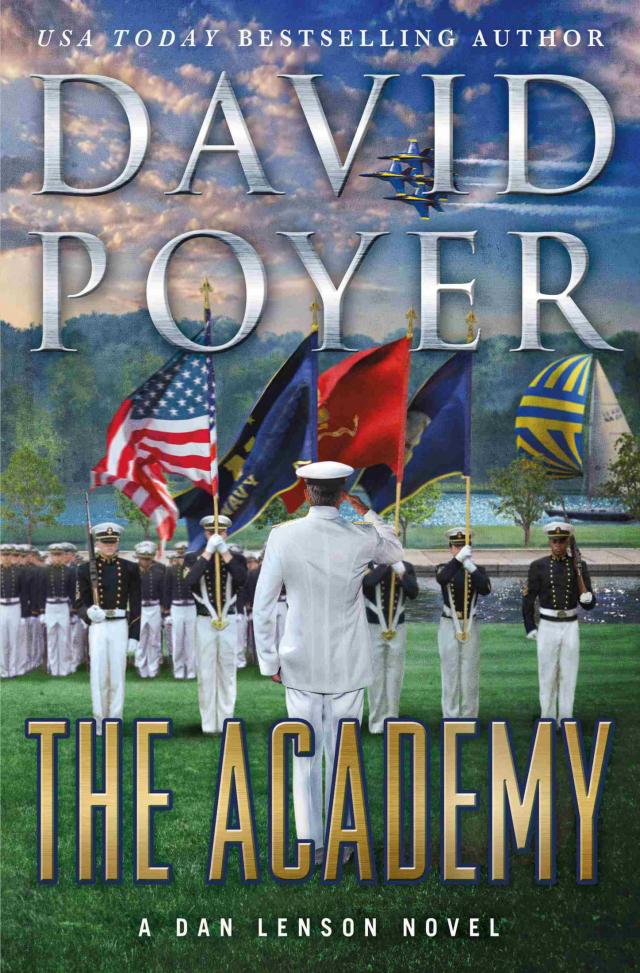
The academy, p.1
The Academy, page 1


Begin Reading
Table of Contents
About the Author
Copyright Page
Thank you for buying this
St. Martin’s Publishing Group ebook.
To receive special offers, bonus content,
and info on new releases and other great reads,
sign up for our newsletters.
Or visit us online at
us.macmillan.com/newslettersignup
For email updates on the author, click here.
The author and publisher have provided this e-book to you for your personal use only. You may not make this e-book publicly available in any way. Copyright infringement is against the law. If you believe the copy of this e-book you are reading infringes on the author’s copyright, please notify the publisher at: us.macmillanusa.com/piracy.
To those who will step into our places in the shield-wall
I will not bring shame upon my sacred arms, nor desert my comrade, but guard and defend our altars and our homes. I will not betray my country, but leave it greater and better than I inherited it. I will obey those appointed over me and submit to the laws. If anyone disobeys or attacks the constitution I will defend it, alone or with others. I will honor the holy things. Let the Gods witness: Agraulus, Enyalius, Ares, Zeus, Thallo, Auxo, and Hegemone.
—Oath of the Athenian Cadets, circa fifth century BCE
I
THE YARD
1
Annapolis, Maryland
Early, before dawn. A morning like so many others, yet different. Streamers of fog eddied above the sluggish dimpled platinum of the river. A closely mowed expanse of grass stretched like a tightly fitted green sheet between a wooded hill, only barely visible through the mist, and a concrete seawall.
The runner was still lean, though his hair was graying. No longer speedy, but still persevering, he rounded the far end of the field and headed back. He could only see a few yards ahead. The layers of early fog twisted above the grass, like spirits uncertain of their proper tenancy.
A sail drifted noiselessly past, propelled by the faintest breath of air. A haze-gray Yard Patrol craft lay motionless, welded to the river surface.
Under Daniel V. Lenson’s running shoes the soft soil, still wet from heavy rain the night before, squished treacherously. He stumbled, nearly turning an ankle. But recovered, and plowed on.
Not many other runners were out this early. Just a few much younger figures in USNA athletic gear.
* * *
July, after a conflict that wrecked two continents. The nuclear exchange had cost both China and the United States cities and cropland. Both still struggled with disease, famine, and revolt.
The Allies had declared victory. But neither side had truly won.
Rear Admiral, Upper Half, Dan Lenson ambled to a halt at the wooden footbridge arching over College Creek. He bent, panting, hands on knees, recalling bitterly how effortlessly he’d sprinted across these same fields as a teen.
Maybe he was pushing too hard. He was still exhausted from five years at sea. Captaining a cruiser at the war’s outbreak, he’d rocketed in rank as America rebuilt its fleet, smashed a submarine blockade, and island-hopped back across the Pacific. Still battling radiation exposure, too, from a cross-country hunt for his daughter. Thank God, she’d surfaced again. Nearly starved, but alive.
“You okay, sir?”
A thin-faced blonde, incredibly young. She seemed to float, defying gravity, as she jogged in place. “Y’okay?” she said again, a mountain twang to her voice.
“Fine … just trying to catch my breath.”
She glanced over a shoulder. “Should I call somebody?”
“No. Thanks. Just … needed a break.” He straightened, fists to his back, trying to get a full breath past the scar tissue in his throat.
She looked him up and down. Taking in, no doubt, the nonreg running gear, the black leggings and nonreg tee. “Do you, um, work here, sir?”
He couldn’t help chuckling. “Yeah, starting today. Actually, I used to run this circuit. Around the Wall. When I was a mid.”
Her eyes widened. “You’re the new Supe.”
When he nodded she glanced around. “At least we got one of our own this time.”
Dan frowned. “Excuse me?”
“Um … nothing, sir.” She edged away. “I just meant, um, welcome aboard, sir.”
He nodded again, still puzzled, but she’d already turned away, accelerated, climbing the arched footbridge with a grace and unstudied power that left him feeling twice as tired.
Forcing reluctant legs into motion once again, he jogged up onto the same scuffed weatherworn planks he’d sprinted so lightly over before … when he was young.
* * *
The grounds of the United States Naval Academy were divided into Upper and Lower. The cemetery and some of the playing fields lay to the north, across College Creek from the original footprint of old Fort Severn. They constituted the “Upper Yard.”
As he clattered off the footbridge, leaving the river fog behind, the Lower Yard came into view. To his left loomed the granite-and-glass bulwark of Nimitz Library. Beyond it rose Hopper Hall, computer science and cybersecurity. To his right, the massive gray slab of Alumni Hall.
Cutting a right, he jogged past the Vietnam Memorial to Decatur Road. He took a knee to catch his breath again beside Worden Field, the Academy’s drill ground. He remembered hot sweating days in ranks, laced into the pigeon-breasted coatee and leggings as his knees buckled and the sweat ran down his face and the suspended rifle gathered the weight of the planet. Across the field stood Captain’s Row, decorous brick homes built early in the previous century. Senior staff lived there.
The captains and commanders who’d work for him, starting today.
Beyond them rose a gray brick wall. And past that, Historic Annapolis, capital of Maryland, a city tiger-fiercely protective of its traditions, history, and its tourist-dependent economy.
Hoisting himself again, he forced reluctant joints back into motion. Past the beaux arts mansarded granite of the main academic buildings. To his right, the Museum, with such obscure attractions as an admiral with four eyes and Chester Nimitz’s saddle.
Stribling Walk. He circled the level, meticulously groomed red brick paths that wound between monuments to fallen midshipmen and stone and bronze figureheads from long-gone ships. Past colorful beds of lilies and tulips and green-patina’d cannon. Past the massive, copper-domed Chapel. Below it, in a hushed crypt, lay a rebel Scotsman, American captain, and Russian admiral: John Paul Jones.
Ahead loomed the sprawling octopus of Bancroft Hall. Mother Bancroft’s eight wings and five stories of French Revival granite had housed the Brigade of Midshipmen since Teddy Roosevelt’s time. In the early morning light it seemed to levitate, ephemeral, illusory, like some castle of dream.
He’d come of age here. Passed from frightened plebe to blasé firstie, from youth to adult. He couldn’t help glancing up to check the window of his old room. And then, to another window, where … yeah, that memory still hurt.
He trotted past the green-painted flanks of captured torpedoes and down through an underpass. Near the eighth wing he angled right again, past the armory, recalling tea dances, racks of rifles, furtive kisses in a coat-filled nook. Athletic buildings, then the verdant expanse of more playing fields, flat as the tarnished gleam of the Chesapeake Bay beyond.
Fatigue dragged at his bones. He slowed to a walk, looking longingly at the tumbled boulders of the seawall. Back then he’d taken them at a sprint, vaulting from block to block, exulting in his body’s quickness, its sure invulnerability.
He frowned. The waves lapped only a few feet below the rocks. Had they lowered the seawall, since he’d been here?
Jogging again, though, he was getting winded. Toward the white-painted foremast of USS Maine, salvaged from Havana Harbor and reerected here. Past a memorial to the submarines and men lost in World War Two. Then north again, past the hulls and masts of the boat basin.
The Yard was wrapped, embraced, surrounded by salt water and the intangible arms of tradition. The river. The bay. The sea. It was beginning to stir now, as cars filled the parking lots, streetlights winked off, as the whole great machine and institution woke to the day.
The day when he would take its helm.
* * *
Not that a new superintendent simply showed up and took charge. He wore the hats of a base commander, a university president, and the boss of a major university athletic department. Dan had requested the billet as his twilight tour. The courtesy was granted now and then to senior officers ending their careers. The possibility had hung fire for months. Then, suddenly, in an all-too-familiar routine, he was behind schedule and had to hustle to catch up.
He’d paid his first official calls while being vetted by congressional staff. He’d phoned two previous supes to ask what their biggest challenges had been and how they’d met them. The nomination itself had happened in the dead of night, the last item of business before the Senate adjourned. He suspected his wife had greased the shipways. Once approved, he’d paid more calls: the CNO, for steering guidance; the chairman, Senate Armed Services; the commandant of the Marine Corps; the secretary of the Navy.
Then on to Annapolis, and the transient quarters above the Officer’s Club. Over the previous week the outgoing supe, Admiral Arminius Cree, had briefed him in. Showed him through the massive official residence where he’d live and entertain. Then, over three days, introduced Dan to the major players. What he cal led the “cost center heads”: the commandant of midshipmen, the academic dean, the athletic director, along with Financial and Legal, the command master chief, and the second-tier department heads.
Unfortunately, Cree had warned, USNA was on a collision course with several icebergs. Dan would have to deal with falling application numbers. Pressure to reduce expenditures. And reports of sexual assault, harassment, and intimidation were at a new high. “Seems like, the more open we are to accusations, the more we get,” Cree had sighed. “Young men and young women…”
He hadn’t finished the sentence, but Dan got the idea.
As a war hero, and holder of the Medal of Honor, he’d be expected to rebuild the Academy’s image.
* * *
Back at the Q. A quick shower, and the first of several changes of uniform he’d go through today.
But there was another formality before he could take charge.
* * *
He stood in the parqueted quiet of Memorial Hall, looking up at the flag.
DON’T GIVE UP THE SHIP, it read, crudely stitched on a blue background. The selfsame banner Commodore Oliver Hazard Perry had flown on Lake Erie, when he’d defeated the Royal Navy and drawn a line between empires.
Below it lay a bronze tablet with hundreds of names. They’d died in flaming gun turrets, in sinking, flooding ships and submarines, in the sky, in muddy trenches and steaming jungles. The Honor Roll immortalized those graduates who’d given everything in the line of duty.
He wished Blair could be here, or his mom. But his mother had passed, and as the first female secretary of defense, his wife had her hands full at the Pentagon. He’d invited a few classmates, though most were retired now.
A cameraman was setting up. Looking into a speckled antique mirror, Dan checked the hooks of his choker whites. Tucked his cap under one arm. Acceptable … but he had to try not to look tired.
“Attention on deck,” someone called, and even the civilians straightened.
A captain stepped to the lectern. “Welcome to the promotion ceremony for Rear Admiral Daniel V. Lenson. For reappointment to the rank of vice admiral and assignment as the superintendent, United States Naval Academy. His most recent billet assignment was with the staff of the chief of naval operations in Washington, DC. He’ll be sworn in by Vice Admiral Shaynelle Hlavna, chief of naval operations.”
Hlavna came striding in trailed by four staffers. She centered herself beneath the flag and nodded. “Stand at ease.”
Dan had asked for a streamlined ceremony, without official honors or the national anthem. Hlavna went briskly through a welcome, and regrets that Dan’s spouse and daughter could not attend, then paused.
“The Academy occupies a special place in the Navy’s heart. Not all our officers, or even our best, graduate from this institution. But it preserves our traditions of heroism and duty. It produces leaders dedicated to a career of naval service, with the potential to someday assume the highest responsibilities of command, citizenship, and government.
“Daniel V. Lenson assumed those responsibilities, in missions behind enemy lines, commanding warships and task forces, and planning and directing significant operations both in peacetime and in war. He holds a variety of decorations in addition to the Medal of Honor. They include the Navy Cross, Silver Star, the Legion of Merit, Defense Superior Service, several Armed Forces and Navy Expeditionary Medals, the Purple Heart, the POW Medal, and various service medals and unit commendations. He also holds significant foreign awards, including the Israeli Medal of Courage, the Korean Order of Military Merit, and the French Legion of Honor.
“One noteworthy absence is the lack of commendation and achievement awards other officers typically receive. But then, true warriors often neither receive nor require those routine attaboys.
“For true warriors are sometimes called to step over the line. And now and then, Dan Lenson has been so bold as to do so.
“Such actions usually end military careers. And for good reason; regulations and orders are lessons learned from centuries of experience. But now and then, individual initiative, that pride of the naval service, proves wiser than the regulations. The mature officer owes the country more. We expect him, or her, to know when to choose a different path.
“But Dan’s not just a hero. In the deepest sense, he’s a servant. He cares, not just for his own people, but for all those affected by his decisions and operations.
“For all these reasons, I believe he’s the right person, at the right time, to lead the Academy into the future.”
She looked his way. “Front and center.”
He had his head down, abashed by the praise. He’d never felt he had much choice in those decisions. They’d always simply seemed the right thing to do.
Though, to be honest, often it had been a close call.…
The chief of staff stepped up. “Attention to orders. ‘Headquarters, Department of the Navy. The president of the United States has reposed special trust and confidence in the patriotism, valor, fidelity, and abilities of Daniel Valentine Lenson. In view of these qualities and his demonstrated potential for increased responsibilities, and in accordance with the authority vested in the chief of naval operations, he is hereby authorized to assume the title and wear the uniform of vice admiral, United States Navy.’”
Hlavna nodded to an aide, who handed her a small box. Reaching up rather awkwardly—Dan bowed to help out—she replaced his epaulettes with the solid gold, silver anchor, and three silver stars of a vice admiral of the line.
She stepped back to applause from the audience. It echoed eerily from the high ceiling, from the paintings of long-ago battles.
Hlavna said, “Please raise your right hand.”
He repeated the oath; that he would support and defend the Constitution of the United States against all enemies, foreign and domestic; that he would bear true faith and allegiance to the same; that he took the obligation freely, and would well and faithfully discharge his duties.
Then it was his turn to speak.
He stepped to the lectern, and paused. He had no lofty sentiments to deliver. No prepared remarks. “CNO, thank you for coming today,” he began. “It’s an unexpected pleasure. Members of the staff, honored guests, ladies and gentlemen. We all have a number of other duties today, so I’ll be brief. But I do want to say just two things.
“First, how humbling this moment is. I hope I can live up to this trust.
“Second, that no one achieves high rank on his or her abilities alone. A couple of people I want to recognize are here with us today.” He nodded at them. “Master Chief Donnie Wenck and Commander Amarpeet Singhe. I’m glad they’ve been able to accompany me here. But far more are absent; on duty, retired, more than a few on eternal patrol. Without them, I wouldn’t be alive, much less be standing here.
“But with the help and advice of everyone here, I’ll give it everything I have.”
* * *
He shook hands and accepted congratulations. He was chatting with the head of the alumni association when the CNO’s aide cleared his throat beside him. “Sir? Admiral Hlavna has to get back. A word before she leaves?”
Dan joined her at the great bronze doors. She crossed her arms. “Dan, again, congratulations. I think this is the right fit.”
“Thanks.”
“Please maintain contact. Your official chain runs through the N7 but you need to keep me and the SecNav in the loop.”
“Will do, ma’am. Weekly updates.”
“Good. New issue: Remember Linwood Naylor?”
“The historian. On my staff for the invasion of Hainan.”
“His book will be a movie soon. It makes you look like a cross between Patton and Halsey. We’re getting calls, invites to talk shows. Interested?”
“Um, we discussed this before, ma’am. I’d rather not.”
“How about going to LA for the premiere? The studio’s invited you. CHINFO will set up travel.”