

Pulphouse fiction magazi.., p.1
Pulphouse Fiction Magazine Issue Zero, page 1
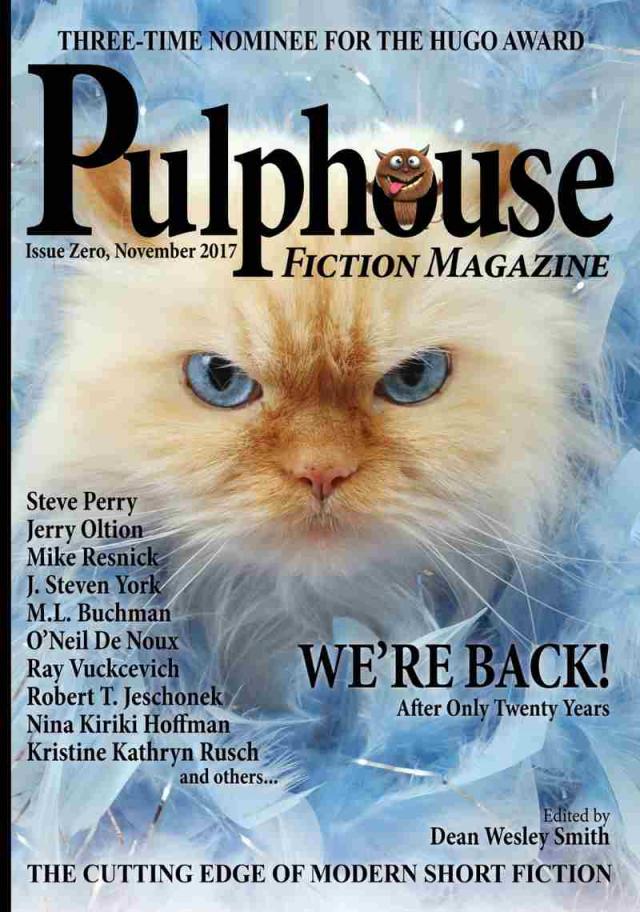


Pulphouse Fiction Magazine
Issue Zero, November 2017
Edited by
Dean Wesley Smith
Contents
From the Editor’s Desk
Kent Patterson
Spud Wrangler
Nina Kiriki Hoffman
Savage Breasts
Annie Reed
The Library Of Orphaned Hearts
J. Steven York
Cooties
O’Neil De Noux
Don’t Make Me Take Off My Sunglasses
Ray Vukcevich
A Breath Holding Contest
Esther M. Friesner
Jesus At The Bat
M. L. Buchman
Inside The Sphere
Dan C. Duval
The Bee Man
Mike Resnick
Catastrophe Baker And A Canticle For Leibowitz
Jerry Oltion
Back To Nature
Steve Perry
Chrome Bimbos
Kevin J. Anderson
The Writing On The Wall
Sabrina Chase
Coyote And The Amazing Herbal Formula
T. thorn Coyle
Salt
Dayle A. Dermatis
Queen and Fool
Kristine Kathryn Rusch
Hand Fast
Robert T. Jeschonek
A Little Song, A Little Dance, A Little Apocalypse Down Your Pants
J. Steven York
“Minions at Work 2.0: 4th Wall Broken”
Subscriptions
Acknowledgments
From the Editor’s Desk
BACK HOME AGAIN
“Knock knock. Anyone home?”
Silence.
“Hello? Anyone here?”
The hinges squeaked and complained as I pushed open the old front door to what had once been a fun place full of stories and art.
Pulphouse.
The big party room looked sort of the same, yet different with most everything covered in dust from the twenty-one years of waiting. The light was low. Everything felt gray and old.
Would it be possible to bring the fun and attitude back?
It didn’t feel possible to me.
I remembered the parties, the fun, the excitement, the great stories from all those years before, now mostly forgotten memories packed away in boxes and haunted by old dead friends. It seemed suddenly that twenty-one years might just be too many to overcome.
I stood in the center of the big room that had been Pulphouse, doubting the very idea of trying to bring life back to the place.
Then, from hidden corners and side doors, hundreds of people jumped forth shouting “Welcome Back!”
Suddenly the dust was gone, the light filled the space and the party had started all over again.
Pulphouse had returned, not dead, not even dusty, ready for a second life.
Who knew that it had just been sleeping?
That is what it felt like deciding to bring back Pulphouse Fiction Magazine and then having the Kickstarter campaign for the magazine be such a success.
Wow! Just wow!
The party has started again and more than anything I want to thank everyone holding this Issue Zero right now for deciding to join the fun and craziness.
So what is Pulphouse Fiction Magazine actually about?
Quality fiction, first and foremost. Fiction that feels strange, a little off, a little attitude. Sometimes a lot of attitude.
Just read the stories in this Issue Zero to see what I mean.
The magazine, starting with Issue One, will have both original stories and reprint stories. This Issue Zero only has reprint stories, but I will wager you will have not read most of them.
Back all those decades ago, Pulphouse Publishing always did an Issue Zero to test out new book lines or magazines. The original incarnation of this magazine had an Issue Zero. I knew we needed to do another to test out the layout, and discover where problems in this new world of publishing might be.
What a difference a few decades make
Let me lay out a comparison between the world of publishing of the original run and this world now. The differences are amazing.
In 1991 when this magazine started, we printed off Pagemaker files from a MacPlus with a whopping 20k storage. We then cut and hand-pasted the pages onto master sheets and delivered the master sheets to a web-based printer sixty miles away (in the snow, uphill both ways).
The covers were printed by a different printer and the two were combined and stapled (saddle-stitched).
We would load up huge boxes full of magazines to take them to the Pulphouse building and then many people would pack them into envelopes and do all the postage-stuff required at that point to ship magazines.
We did that process for 20 issues if you count Issue Zero.
Now, with the new incarnation, everything is laid out on the computer, sent directly to the printer electronically, and that’s it. The electronic subscriptions are laid out and sent directly to subscribers.
For the first run in 1991, we sent copies to newsstands just in the US to sell. Today the paper and electronic copies of this magazine will be available for sale in most online bookstores all over the world.
In the old days, the copies vanished after a month or so. In this new world you can buy a copy of any issue long after it has come out.
In other words, this new world is so much better and easier.
Who is behind Pulphouse Fiction Magazine?
No magazine of this scale could ever be done by one person. Not possible. And certainly not me.
I am the editor, the guy who picked the stories way back in 1991 for the first incarnation and I am still picking them today. I am the voice of the magazine.
Back in 1987, Kristine Kathryn Rusch and I decided to start Pulphouse Publishing with an anthology series called Pulphouse: A Hardback Magazine that Kris edited. That got us many award nominations and we even won the World Fantasy Award at one point.
That original idea grew into a good-sized company with Debra Gray Cook, now Debra De Noux, as a major center figure. At one point, Pulphouse filled a two-story office building with employees and, except for this magazine, we pioneered “on-demand” printing for our books.
Pulphouse Publishing Inc. shut down and dissolved in 1996.
Years went by.
In 2010, Kris and I decided it was time for us to jump back into our own publishing company again. We started WMG Publishing, which became a full corporation in 2012.
Now WMG Publishing employs nine people, has three brick-and-mortar stores, and has over 700 titles in print.
WMG Publishing is run completely by Allyson Longueira, the CEO and publisher. Besides being a brilliant publisher, she is also a great editor and a brilliant cover designer. Allyson is the heart and soul of WMG Publishing.
Josh Frase gets to step into the role of managing editor of this magazine. He will not only help on the subscription side, but be in charge of the website we hope to bring up into an interactive and fun place as time goes along.
Plus Billy Reese, as director of sales for WMG Publishing, and Gwyneth Gibby, associate publisher, will help keep the magazine headed in the right direction.
So for this magazine, this incarnation, I am the editor and voice and Kris uses a firm hand to keep me on track. Kris and I weren’t sure we should start this party again. But now we are glad we took the chance and opened the doors back up.
It really wouldn’t be possible without the wonderful support your readers and subscribers have shown already. That old dusty memory of a project long buried in the past now feels fresh and alive and ready to go.
I hope you enjoy all the wonderful stories in this test issue as much as I did remembering them and putting them all together.
Onward. It’s going to be fun.
Spud Wrangler
Kent Patterson
Kent Patterson was a polio survivor and one of the nicest and smartest men I have ever had the pleasure to meet. Those of you lucky enough to be young enough to not remember the polio epidemic and the vaccine that saved us, do go look it up. A nasty disease.
Kent’s body was ravaged by his days with polio, yet it never seemed to slow him down. As one of the longest-lived survivors, Kent decided to take up fiction writing and he did it with his usual charm and wit and incredible drive.
Everyone who has read a Kent Patterson story has a different favorite. This is mine. I published it in issue #17 of the original Pulphouse Magazine in 1994 and a short time later Kent finally lost his lifetime fight with polio. But during his short stint writing fiction, he had sold to F&SF, Analog, Pulphouse, and many other magazines.
And thanks go to Jerry Oltion for doing the fantastic work of keeping Kent’s wonderful stories in print and available after two decades.
With the suddenness of a rifle shot, a desert thunderclap rumbled and rolled across the Idaho plains. Here and there scattered rain drops fell, kicking up tiny puffs of dust where they hit the dry ground.
“That there were a close ’un,” drawled old Parley McKonky. Clucking gently, he reined in his horse. “Now, now, there, there,” he said, patting the horse’s neck. “Just a little desert storm, and it ain’t agoin’ to eat you.” The horse trembled, its nostrils flared and its eyes wide with fear.
Brig Clark’s horse stood placidly as a cardboard cow. Couldn’t even hear it thunder, Brig thought with disgust. Of course they always gave the oldest horse to the newest wrangler. A fourteen-year-old boy got treated nothing better than a baby when wranglers were concerned. He glanced at Parley. The old man’s face was as wrinkled as a outcropping of lava. Hat off, head raised, he sniffed the air. So did his horse.
“Boy, there’s trouble brewing.” He looked at Brig. “You’re going to earn a wrangler’s pay today. That lightning hit close. Real close. Somewhere around Twin Missionaries Springs. Now tell me what you smell.”
Brig sniffed. He smelled mostly horse, sage brush, and maybe a touch of grungy underwear. He took off his hat and tried again. There was something else. The musty scent of desert rain. And something else yet, a faint aroma which reminded him of his mother’s kitchen.
“That’s the smell a spud wrangler fears most, son.” Parley gave him a keen glance. “That smell, son, is baked potato.” He raised his hand for silence. “Put your ear to the ground, boy, and listen.”
Brig climbed down from his horse. Holding the reins in one hand, he lay flat. Raindrops speckled the dirt with little brown craters. Brig placed his ear on the ground and strained to hear. He heard leather reins creaking, the hoarse breathing of his horse. A hoarse horse, he thought wildly.
Then he heard it. Not a sound, really, but a trembling in the ground.
“That’s a stampede, son, and it’s coming our way.” Parley lit a cigarette, the smell of tobacco permeating the air. “They’re coming our way, and they’re coming hard. And there ain’t one damned thing between them and Snake River Canyon but you and me.”
An image of Snake River Canyon flashed through Brig’s mind. You popped over a little ridge and there it was, a sheer cliff of black lava dropping four hundred feet straight down. He’d seen a horse fall off it once. Ants had eaten the remains. There wasn’t a piece big enough to interest anything else.
“That herd’s the entire year’s crop.” Parley looked at Brig. “If the panic spreads to the main herd, which it will if we don’t stop it—,” his voice dropped off. “Well, it’ll be a mighty long, hungry winter in Idaho. We got maybe two hours.”
“But I don’t have a watch.”
“Take a look at where the sun is,” said Parley, pointing to the sun which just now burst out from behind the storm cloud. “See where it’s going to hit Hanged Man Spike?” Brig looked. Hanged Man Spike was a lava outcropping that stabbed into the Western sky like a broken tooth. “By the time the sun hits the Spike, the herd will hit the Canyon.”
“What we going to do?” Brig asked, ashamed at the quaver in his voice.
“We got us a few minutes to spare. I’m finishing my smoke. You, well, boy, if you got to go, you better go now. You might not get a better chance all day.”
Brig looked around for a rest room, or even a tall bush. Nothing for miles except tumbleweeds, scanty patches of cheat grass, and knee high sage brush stretching off in all directions in rows as neatly as if it had been planted. He took a deep breath, unzipped, and peed standing in the open desert like a man, leaving a miniature Snake River Canyon in the dust.
He remounted his horse, pulled an Idaho Spud candy bar from his saddle bag, split the wrapper with a single thrust of his thumbnail like his daddy had taught him, and began to eat. The rich, chocolate marshmallow taste mixed with the flavor of horse and desert dust.
Now the air reeked with the smell of baked potato.
The ground trembled. Brig munched his candy bar. Control yourself, he told himself. Real wranglers don’t sweat. He stole a glance at Parley, puffing his smoke calmly as if the stampede were a radio show on a station he couldn’t get.
Now the trembling in the ground shook the air. Parley’s horse pranced back and forth, rolling the whites of its eyes and sawing its mouth against the bit. Even Brig’s horse lifted its head and whinnied, staring off to the north where a low ridge of lava blocked the view. “Finally something woke you up,” Brig whispered to the horse. “I thought you was dead.”
The rumbling became a roar. Now even Parley stared at the giant clouds of dust billowing up in the North. He glanced at Brig. “You ready, son?” he shouted over the roar.
Not trusting himself to speak, Brig nodded.
“Remember, boy. We’re all there is between the herd and the canyon. We don’t turn ’em, you know the only thing we’ll need?”
A brown tidal wave of potatoes burst over the low lava ridge. A flood of Idaho Number One Bakers the size of bread loaves, tumbling end over end, eyes white with panic.
Parley’s last few words died in the thunder of the stampede. But the joke was ancient, and Brig knew it well. If the herd went over the canyon wall, all a spud wrangler needed was five hundred tank cars of gravy.
“Ki yi yee yee, roll you bakers roll!” Parley shouted the traditional cry of the spud wrangler. His horse shot forward like a cannonball. Through the last of his candy bar, Brig tried shouting too, but his mouth was so dry he only succeeded in spraying himself with chocolate marshmallow and bits of coconut. He glanced at the hordes of potatoes now streaming through every gap in the lava ridge and rolling down the plain as irresistibly as Noah’s flood. His horse whinnied in fear and, in spite of Brig tightening the reins, it shied backwards, away from the thunder of the onrushing spuds. “You’re making a coward of me, horse,” Brig said.
But it was him making a coward of himself. He whose sweaty hands slipped on the reins, whose breath came short, whose pulse pounded like Satan’s own trip hammer in his brain. He tried to yell a “Ki yi yi” but the sound turned to dust and chocolate in his mouth.
Spur your horse, spur you coward, he screamed in his mind. But try as he might, his spurs seemed to have a will of their own. Unbidden, tears sprang to his eyes. Bless the Lord that Parley was halfway across the flat and couldn’t see.
Turn back. Get out of here. For a second he decided to give the horse its head, race away from that implacable, thundering mass of spuds, get away and live.
But, even as his horse turned, an image flashed through his mind. The wranglers gathered around the chuck wagon after a hard day’s work. Tired, aching, maybe hurt, but each knowing he’d done his share, that he’d never let a partner down. The Idaho sunset, turning the desert purple and pink, with maybe a single puff of cloud flaring gold in an empty sky. Night slipping across the desert plain, the camp fire crackling, smelling of sage. A couple of prime Idaho Number Ones turning on a spit, the comforting sound of male voices laughing, joking about big spuds and beautiful women.
If he turned away now, he would never be one of them. Oh, no one would say a thing. Not by a whisper, not by a hint, would anyone breathe the word “coward.” No one would have to.
But in the morning when he woke up he’d find a potato peeler by his bed. There was nothing written down, but the rule was iron. Men herded spuds. Cowards were only fit for making french fries.
Brig closed his eyes. “Ki yi yee yee,” he squeaked. He opened his eyes and shouted louder. “Ki yi yee yee.” Louder yet! He spurred his horse. It shied. He spurred harder. “Ki yi yee yee!” he screamed at the top of his voice. “Roll on, you bakers.” Hooves drummed on the dry desert dust as his horse headed for the rampaging herd of potatoes.
Minutes turned into hours, days, as Brig charged down the long lines of the potato herd. Screaming, shouting, waving his arms and brandishing his long black spud masher, he and Parley drove the huge lead spuds back. If these turned, the herd followed, rumbling along like a freight train. But sometimes the lead spuds resisted even the masher, and then Brig would resort to the spud wrangler’s greatest and most ancient weapon, holding his arms overhead in the mystical half circle that for reasons unknown drove terror into the very starch of even the toughest tuber. That always worked, though no spud wrangler knew why.






