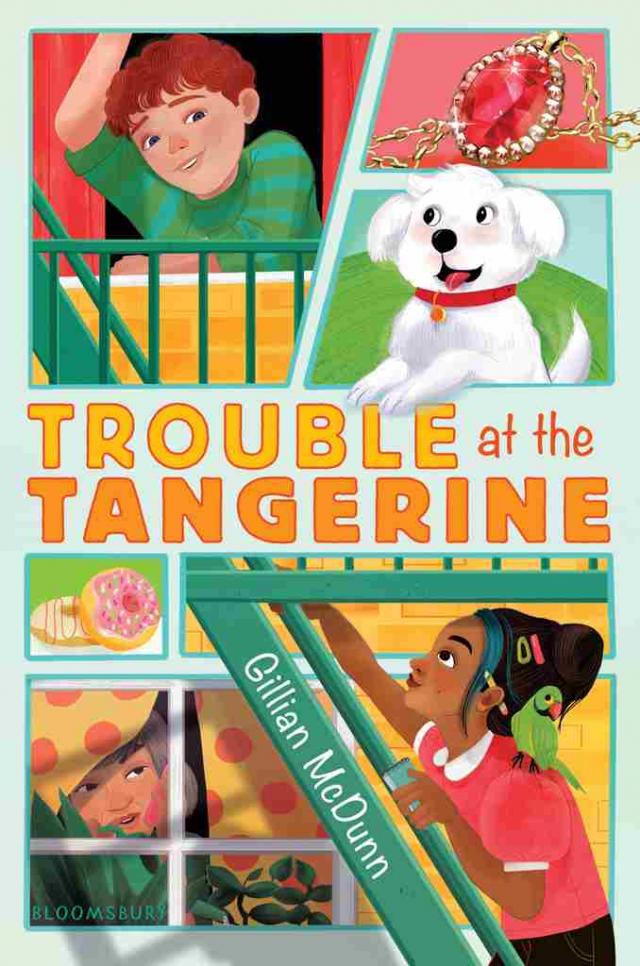
Trouble at the tangerine, p.1
Trouble at the Tangerine, page 1


Also by Gillian McDunn
Caterpillar Summer
The Queen Bee and Me
These Unlucky Stars
Honestly Elliott
When Sea Becomes Sky
For Gauri
Very few of us are what we seem.
—Agatha Christie
CHAPTER 1
another version of home
Simon Hyde’s parents were the kind of people who felt most at home when they were not at home.
“Why settle for ordinary? The Hydes are searching for extraordinary,” Dad was fond of saying. “To find that, you can’t stay in one place.”
Simon had placed lobster traps in the Atlantic and roped cattle on ranches and squeezed into the lofts of tiny homes. He’d snowshoed through the Rockies, zip-lined through treetops, foraged for mushrooms, and dived off cliffs.
But there was one thing that Simon had not experienced. He had never had a real home. A forever home. The kind of place where he knew all his neighbors. A place where he had lots and lots of friends.
For the past eleven years, the family had moved from one part of the country to the next, each time traveling in their ancient vehicle, Vincent Van Go—Vincent for short. If someone charted their routes crisscrossing the map, it would look like a connect-the-dots page gone absolutely berserk.
Their adventures were documented on his parents’ social media account, The Hydes Go Seek. It had started back when Simon was a baby, just as a way for friends and family to keep up with their activities. But their following had exploded over the years. Now, just over a million strangers had a bird’s-eye view into the life of Simon and his parents each week.
They went to amazing places. But no matter how perfect the scenery—no matter how extraordinary the adventure—it was only a matter of time before his parents became restless.
“Wouldn’t you like to live on a houseboat, Simon?”
“Did you know it’s possible to see the northern lights from certain parts of Idaho?”
“If we lived in a cabin, you could take a snowmobile to school.”
“I’ve always wanted to live somewhere with blueberry bushes in the backyard.”
Together, they’d lived in twenty-six different places—twenty-seven if you counted Tuscaloosa, which Simon did not. He barely remembered it. They’d stayed only three weeks before moving to Kalamazoo. They’d only lived there for only eight months before moving to Pensacola. And so on and so on.
So far, each version of home had ended the same way. After a time, they’d say goodbye to classmates and neighbors. Then they’d pack up Vincent and drive to the next version of home. Each move meant another school. Another set of friends. Another chance to be the new kid.
It was summer, and the Hydes were moving again. But this time was going to be different. This time, Simon was going to find his forever home. Even if his parents didn’t know it yet.
CHAPTER 2
the plan
Simon liked to have a plan.
Plans do not have to be complicated. In fact, some of the best plans are simple. Such was the case for Simon’s plan for moving to a new place—his two-part, top-secret system he called Code Name Chameleon.
Code Name Chameleon, Part One: Blend in.
In nature, camouflage is key. Things that stand out tend to get noticed. Things that get noticed tend to get eaten.
The rules were the same for new kids. Simon did not want to be noticed. He definitely did not want to be eaten. So the first step was to make sure he did not stand out in any way.
In Abbottsville, blending in meant playing soccer and wearing tall, solid-color socks.
In Chase Park, it meant marching band and specially tied shoelaces.
In Brookton, it meant skateboards and striped shirts.
In Owens Grove, it meant chess championships and blue hair.
In Cape Piddo, it meant surfing and friendship bracelets.
The proof of his success was clear. Simon was never the person with the most friends, but he had also never been eaten.
Code Name Chameleon, Part Two: Don’t be weird.
Deep down, Simon was a kid who loved rocks and gems. A kid who would spend entire days reading adventure and fantasy books. The one who hated heights. The one whose stomach tied up in triple knots every time he moved.
Were these things all that unusual? Maybe not. But it was safer to keep those parts of him squashed down until he got to know a new place. The squashing stage was supposed to be temporary—eventually, he’d have friends who saw him for exactly who he was.
At least, that’s how the plan was supposed to work. The problem was that as soon as Simon’s new-kid status started to fade, it seemed like his parents were already planning their next move. They called themselves “digital nomads”—between the money that their social media presence made and their regular jobs, which were computer-based, they could work from absolutely anywhere.
Even as they’d planned for the move to Rigsby, Dad had eyed Simon’s things.
“Remember, we have to travel light.”
Simon knew the requirements by heart: he could only take what could fit in Vincent. Two medium boxes. One backpack. But there was one additional thing that was absolutely nonnegotiable: his rock collection.
He turned sideways to hide the size of the box. “I already packed my bag and boxes.”
Dad raised an eyebrow. “What’s that you’re holding?”
Simon clutched his collection protectively. “It’s just one small piece of every place we’ve ever lived.”
Dad looked skeptical. “Some people would say that carrying rocks from place to place is the exact opposite of traveling light.”
Simon narrowed his eyes. “Some people would say that my collection would be smaller if we moved less often.”
At this, Dad had rumpled his hair and grinned before walking away. He thought Simon was joking. But Dad didn’t know about Simon’s super-top-secret plan. The one he called Operation Rigsby. This was the plan his parents knew nothing about. It had three simple steps, and Simon had already completed the first two.
Step One: Find the perfect town. Simon had investigated and researched. He read so many top-ten lists that he began to see them in his dreams. He did Google Street View until his eyes felt like sandpaper. Until he found the perfect place. A city that was not too big and not too small. A city that was just right, with a bustling downtown and plenty of bike paths and public transportation to make Dad happy. For Mom, he wanted museums, farmers markets, and proximity to the beach and mountains for their day-trip adventures.
Step Two: Move there. He’d printed out multiple top-ten lists about the city’s restaurants and bookstores and parks and coffee shops. He sent his parents links to video tours and pertinent posts. Before he knew it, his parents were starting to talk about how fun it would be to move to Rigsby.
Step Three: Stay there forever. This was the most important part—and also the most complicated. He’d have to keep an eye out for any signs of restlessness. He’d have to make sure his parents truly loved every part of their new city.
Because Simon wasn’t looking for another version of home. This time, he was looking for the real thing.
CHAPTER 3
a forever kind of feeling
“You have arrived,” the voice on Mom’s phone chirped as Vincent groaned to a stop in the apartment building’s loading zone.
Mom patted her pants pocket. “I’ve got the keys right here. Why don’t I go ahead and unlock the apartment? Maybe I’ll grab a few pictures for The Hydes Go Seek on the way in.”
Simon brightened. “I’ll start unloading.”
Mom and Dad exchanged glances.
“What?” Simon asked. “I can handle a cross-country move with one hand tied behind my back.”
Dad scratched his head. “You have to admit it’s a little more challenging with a busted fibula.”
Simon frowned, staring at his bright green fiberglass cast, which was hoisted across Vincent’s backseat. A broken leg—his souvenir from the last town they lived in, when he’d decided to ignore his fear of heights and try to climb a tree. Everything had been fine until he looked down and his brain had become a spinning pinwheel of dizziness. After that: a quick fall, followed by a loud crunch. Then: a summer spent in a cast.
Dad caught his eye. “You can sit in the back and hand me what I need. That would be really helpful.”
Simon reached for his crutches, smiling to himself. He clambered out of the van, swiveling his head to take in their new street—the steady streams of cars and bikes commuting to work, a city bus roaring past, the scent of fresh bread from the corner bakery curling around him. Rigsby felt alive. Simon had a good feeling about this place. A forever kind of feeling.
As he circled to the back of the van, Mom was snapping photos for The Hydes Go Seek. Then she hurried up the steps. She placed a brick to prop the front door and disappeared inside the building, which was just as it had looked online—five stories tall and made of yellow brick, with arched windows and a deep orange roof. To the left of the door was a sign that read Tangerine Pines.
Dad followed Simon’s gaze, squinting at the building. “What’s that supposed to mean?”
Simon tore his eyes away from the bustle of the city. “Hmm?”
Dad pointed at a sign. “Tangerine Pines—an odd name, don’t you think? One, there are no tangerines. Two, there are no pines. Three, there are no tangerine pines, whatever those are.”
H eat crept up the back of Simon’s neck. He wanted Dad to like this place—to really like it. Making fun of the building name was a bad way to start out.
He cleared his throat. “It’s just a name. It doesn’t have to be anything deep.”
Dad scratched his head. “We’ve stayed in places with corny names before. It’s usually not a good sign. Remember the Rose Petal Apartments?”
Pictures didn’t always tell the whole story. Sometimes listing photos were accurate, and sometimes they stretched the truth a little. When they’d picked up the keys for the Rose Petal, the Hydes discovered crumbling pink stairs, a swimming pool overflowing with slippery green algae, and, to top it all off, a rowdy family of skunks that had taken up residence in the primary bedroom. In that case, the truth had been stretched a lot.
“Come on,” Simon said. “Those little skunk babies were cute.”
Dad grimaced and continued to rummage through the van.
“Rigsby is going to be perfect,” Simon said. “I just know it.”
He continued to look around. Even though he didn’t want Dad to criticize their new home, he actually did think names should have significance. It was reassuring to rely on logic and order and answers. Everything meant something. It was just a matter of knowing the right place to look.
To the left was a much larger building, which towered over the Tangerine Pines. Made of modern metal and cool glass, a sign with sleek lettering read The Lofts on High Street. That was a clear, straightforward name.
Then he turned his head to the right. This building was slightly smaller than the Tangerine Pines but more impressive, with white brick, lush green topiaries, and gleaming red doors. Its corners were sharp, its paint was crisp, and the uniformed man out front had exceptional posture.
He tilted his head in its direction. “There’s no sign on that one.”
Dad hefted two boxes in his arms and made for the stairs. “That’s not an apartment building—it’s a house.”
Simon let out a low whistle. “A house? More like a mansion. They have their own doorman!”
Dad was already halfway up the steps. “I think the Tangerine was originally a single residence but was converted into apartments at some point. That doesn’t explain the goofy name, though.”
Dad continued up the steps. When he reached the front doors, he wedged his foot in the gap and swung it open to create enough space for him to step through.
Simon leaned against the van, studying his surroundings. Even though he’d been anticipating their move to Rigsby for months, it felt completely different to be there in person. The traffic was steady—cars, trucks, and buses. A delivery bike gracefully swerved around the van. Even on the sidewalks, people seemed to move with purpose. Dogs on leashes stayed with their owners and didn’t stop to sniff. Babies in their strollers had determined expressions as they crammed cereal puffs into their tiny mouths. The trees in front of the building were dotted with pink flowers, like they had been decorated specially for their arrival.
Even above the noise of the street, Simon heard her before he saw her.
“Incoming!” A two-wheeled scooter careened down the sidewalk. On top of it was a tall girl with medium-brown skin and dark hair with a streak of turquoise—no. Seafoam green. A green bird perched on her shoulder.
The bird squawked. “Incoming! Incoming! Who’s a pretty baby? Who’s a pretty boy?”
They whooshed past. Then the girl cut the scooter wheels left to dodge a pedestrian and then at the corner turned right, vanishing from view.
Simon looked around. In some places, a girl and a bird riding a scooter would be noteworthy. But here, no one seemed to blink an eye. He smiled to himself. This was going to work out just fine for the Hyde family. A warmth spread through him. His plan had come together perfectly.
If only the boxes could float up the stairs and unpack themselves. He ached to be settled as soon as possible. Balancing on one leg, he swung the backpack onto his shoulders; then he hobbled toward the stairs, taking them one at a time. Simon couldn’t wait until he got his cast off. He would never take walking up a flight of stairs for granted again.
He was halfway up the stairs when he heard a voice.
“And just what do you think you’re doing? Are you trying to get the whole building robbed?”
CHAPTER 4
an unpleasant welcome
Simon was so startled, he almost toppled down the stairs.
In the doorway of the apartment building stood an older white man with a gray handlebar mustache. He wore a paint-splotched coverall with stitching above the left chest pocket that read Oscar. The added height from the steps combined with the scowl on his face made him seem like he was a giant.
Simon gulped. “I don’t want anyone to get robbed!”
Oscar glowered. “We never prop doors. An open door invites trouble. You’re not trying to let in some of your hooligan friends, are you?”
Simon’s mouth dropped open. They’d only just moved there—he didn’t even have any friends. And if he did, they wouldn’t be hooligans.
“I’m really sorry,” Simon said. “I didn’t know.”
The man squinted. “You’re moving into 3B? Last name Hyde?”
Simon pointed at Vincent. “My parents are unloading boxes while I watch our van.”
At this, Oscar came to the top of the stoop. He wore a pair of thick-soled shoes that squeaked with every step. “I’m the super.” He pulled a rag from his pocket and wiped his hands.
Simon leaned on his crutches and took a deep breath. It was too early to be off on the wrong foot with someone in Rigsby—especially someone in charge of his new building. He put on his friendliest smile. “I’m Simon.”
Oscar made a vaguely disapproving clicking sound with his tongue. “You’re in the city now, kid. You can’t invite crime in the front door like that.”
Out of the corner of his eye, Simon realized that the girl with the scooter was riding past again. She still had the bird on her shoulder. This time, she slowed as she passed, like she was trying to overhear the conversation.
Simon flushed. “I was watching the whole time. No one went in or out.”
Oscar snorted. “What would you do about it anyway— a pip-squeak like you.”
“I’m eleven and a half,” Simon said sharply.
“Like I said, a pip-squeak,” Oscar replied. “With a broken leg, no less. A kid can’t keep a whole building safe. This is the city! There’s crime everywhere out there.” He peered suspiciously up and down the street.
Simon followed his glance. It seemed like a normal-enough street. He shrugged. “I’ll be more careful.”
Oscar squinted. “One more thing—your family has been receiving mail at this address for weeks, even though your lease didn’t start until today. That’s considered bad form, just so you know.”
Simon looked at Oscar sideways. This didn’t sound right at all. Simon loved plans and systems, and the Hydes’ relocations were always done fastidiously and exactly. When they were between addresses, everything was forwarded to his parents’ assistant, who scanned any important documents. Mom and Dad wouldn’t want papers piling up before they arrived.
Simon was tempted to tell Oscar how wrong he was, but he swallowed his arguments and instead put on his extra-polite smile. “Sorry about that. I’ll definitely pick it up just as soon as we move in.”
Oscar waved his hands impatiently. “See that you do.”
The apartment building door swung open, and Dad stood there for a moment, glancing between Simon’s face and Oscar’s. He took two steps toward them.
“Thomas Hyde,” he introduced himself, reaching out for a handshake.
Oscar hesitated, then slowly offered his hand in return. The walkie-talkie on his hip squawked, but he ignored it.
Dad nodded. “Is there a problem?”
“Everything’s fine,” Simon said quickly. “There’s a rule against propping the door open, but it’s fixed now.”
Oscar made a noise that sounded like harrumph. He turned to leave, shoes squeaking with every step. The double doors closed solidly behind him. Simon breathed a sigh of relief.
Dad looked at him. “Not the friendliest guy, huh?”