Care of, p.1
Care Of, page 1


Copyright © 2021 by Ivan Coyote
McClelland & Stewart and colophon are registered trademarks of Penguin Random House Canada Limited.
All rights reserved. The use of any part of this publication reproduced, transmitted in any form or by any means, electronic, mechanical, photocopying, recording, or otherwise, or stored in a retrieval system, without the prior written consent of the publisher—or, in case of photocopying or other reprographic copying, a licence from the Canadian Copyright Licensing Agency—is an infringement of the copyright law.
Library and Archives Canada Cataloguing in Publication
Title: Care of / Ivan Coyote. Other titles: Care of (2021)
Names: Container of (work): Coyote, Ivan, 1969- Correspondence. Selections.
Description: Collection of correspondence written to and by Ivan Coyote.
Identifiers: Canadiana (print) 20200391798 | Canadiana (ebook) 20200392387 |
ISBN 9780771051722 (softcover) | ISBN 9780771051739 (EPUB)
Subjects: LCSH: Coyote, Ivan, 1969-—Correspondence. | CSH: Authors, Canadian (English)—21st century—Correspondence. |LCSH: Storytellers—Canada—Correspondence. | LCGFT: Personal correspondence.
Classification: LCC PS8555.O99 Z48 2021 | DDC C813/.6—dc23
Lyrics on this page from “Proud Crowd” © Nemesis Publishing. Reproduced with permission from Ferron.
Lyrics on this page from “Mercy Now” by Mary Gauthier © 2005 Mary Gauthier Songs. ALL RIGHTS RESERVED.
Book and cover design by Kate Sinclair
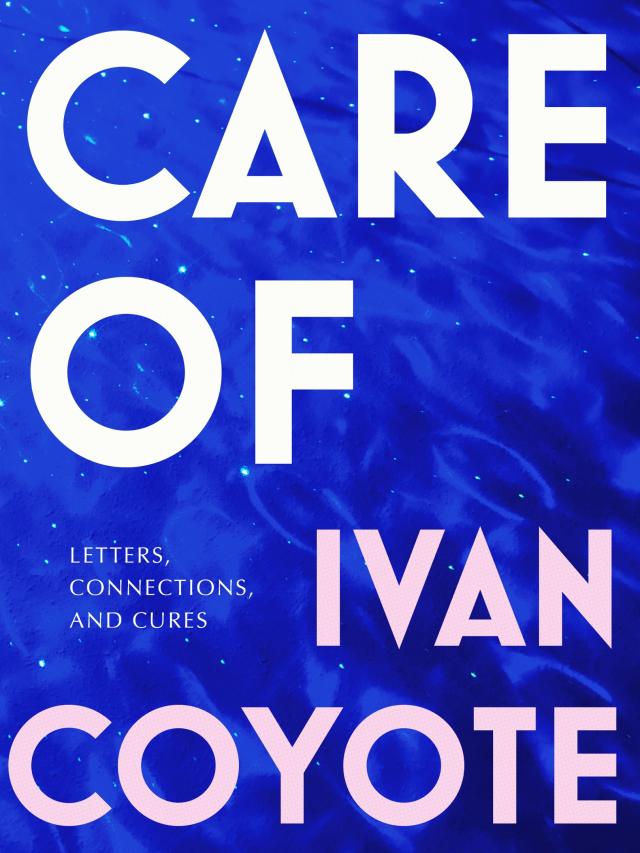
Cover art: Ivan Coyote
McClelland & Stewart, a division of Penguin Random House Canada Limited, a Penguin Random House Company
www.penguinrandomhouse.ca
a_prh_5.7.0_c0_r0
This book is dedicated to every person who ever took the time to write me a special letter, whether delivered to me by snail mail, a hand-passed note, a text, a direct message or an email. I keep and remember them all.
TABLE OF CONTENTS
Cover
Title Page
Copyright
Dedication
Introduction
1: All of My Other Uncles
2: Your Kate
3: Our Fathers
4: Shiny-Shoed Storyteller
5: Dear Florence
6: Kids These Days
7: Soldiers Without Country
8: Everything Has Changed
9: All of You
10: Don’t Call Me By Your Deadname
11: And the Water
12: Distinguished Lecture
13: Two Kinds of Blue
14: Then There Was This One Time
15: Volcano
16: Teeter-Totter
17: Gabardine Pants
18: On Camera
19: Gentle Melt
20: Keep Tender
21: Back Home
Acknowledgements
About the Author
INTRODUCTION
I’ve been a road dog all of my adult life. My very first vehicle was a camper van, and I still miss it. Even before I became a touring writer and storyteller, I was a professional suitcase packer, a world-class map reader, a finely-tuned leaving machine. I wear through the soles of new boots ten times faster than I do bedsheets. Travel has been the spine and skeleton of my career for coming up on thirty years now. The two things all of my bones know best is telling stories on a stage, and the feeling of wheels or wings and road rolling under me.
Everybody on this continent remembers the week it all stopped. That weird week in mid-March of 2020 where the news about the virus wasn’t coming from somewhere far away anymore, suddenly it was coming from our own hospitals, our own mouths, we were all breathing on each other still, and we needed to stop.
I was on the road when it happened. I had just finished a tour of high schools and libraries on Vancouver Island in the waning days of February, back when we were watching the news in China and Europe with one eye and washing our hands more often, but pretty much doing all other business as grinding and crowded as usual. In early March I had skipped up to the Yukon for three days to film a documentary, and then flown to Ontario. I was at my partner Sarah’s place in London, Ontario, for a quick two-day visit before heading to St. Catharine’s for a couple of gigs at Brock University.
I got a text at 9:45 p.m. on Thursday March 12th that both of my shows the next day had been cancelled. Luck and circumstance found me under Sarah’s roof that night, not in a hotel room, and I am still grateful for that. By the following Monday most of the red dots on the next three months of my calendar had evaporated, along with all of my plans, and my main source of income. Sarah is a songwriter and touring musician, and we found ourselves sitting on the couch next to each other, answering emails and making a long grocery list with a lead-flavoured knot growing in both of our bellies.
Both of us had spent the better part of our best years practising the craft of, buying the gear for, and logging the hours in to becoming the very best live performers we could be, and overnight, all of our talents had been rendered irrelevant in this global pandemic landscape.
We did what everyone else we knew was doing. We bought a bag of rice, and canned beans, and counted how many rolls of toilet paper we had left. We watched the numbers tick upwards on the news, and we disinfected our groceries with our dwindling Lysol wipes. We told ourselves over and over how lucky we were to have a little money saved up, to have each other, to still be healthy. We will make the best of this time off of the road, we said. I can write some new songs, she said. I can work on my mystery novel, I said.
Except I couldn’t. The story I was working on flips back and forth between 1986, where a small-town 19-year-old local boy goes missing from a bar one Friday night, and the present day, when his remains are finally discovered in the bush by a dog walker, just shy of 35 years after he disappeared.
I was in the groove for the 1986 parts, I was listening to “Jump” and “Born in the U.S.A.” and “When Doves Cry” on repeat for inspiration, and it was working, but my words froze in my head when I tried to write about this present day. I spent hours staring at the flashing cursor on my computer screen. I made chili. I skipped rope outside in the carport because the gyms were closed. I cleared out a corner of Sarah’s second bedroom and bought a little desk so I had my own place to work. Still. Imagining a world in this unimaginable time and place was impossible. Who could write fiction at a time like this?
So, I started answering my mail. I get a lot of mail. Emails, Twitter, Facebook and Instagram messages. Handwritten letters passed to me at the book signing table at a festival, a rain-soaked and blurry blue-inked note scrawled on the back of a flyer and left under the windshield of my car after a gig two years ago. Since 2009 or so I have been keeping both an electronic and a hard copy file of special letters, ones I always meant to sit down and answer properly, if and when I had the time. If and when was now upon me, and so I did.
This book does not answer all of my mail, not even close. I still owe so many beautiful writers a response to their missives. What I did was follow my storyteller’s heart, and I chose the letter that most called out for an answer on the morning of each day I sat down to write.
Some of my replies stretched out into four or five pages. I answered each letter with a story that the original letter shook loose from my ribcage. Outside my office window the snow melted and the green fingers of the garden started to burst out of the dirt in the backyard. I had the time and the stillness to watch the ants crawl over the peony buds and learn the names of the birds arriving and departing the feeder we hung from the spruce tree. I had time to drink a second coffee in my bare feet. I had time to write letters.
By summer solstice all of those letters, and the stories and souls and substance they contained, were beginning to gather themselves into a much bigger conversation. Themes began to emerge. The longing of an older lesbian to be seen and remembered was answered and echoed by the call of a much younger queer writing to me in search of an elder. A letter from a lonely daughter found itself on my desk in the company of words from a proud and fearful father of a recently out trans son. Ex-evangelicals and the excommunicated were both communing in my email inbox, waiting for an answer. Some of the letters I wrote took me days to compose, and tinker with and tweak. I took deep breaths and long showers, and even longer walks. I wanted my replies to these letters to be perfect, especially the ones that I had been keeping safe for five or eight or even eleven years before crafting the kind of answers that they so deserved.
By the time September waned and became October, and it was time to prune back the faded green stalks of summer and get the garden ready for the snow to return, the much anticipated yet still somehow shocking second wave struck the world. I was afraid, but not like I had been in April. The unimaginable was now strangely familiar. I found myself always tired, even though I had much more time to sleep.
By this time those letters and my responses had merged themselves into the manuscript for this book. I started the process of contacting all of the letter writers by phone or text or email or Zoom, to ask them if they would consent to their letter to me being included in this now very extended and intentional conversation. A conversation with a remarkable collection of writers about family, and memory, and addiction, and loss, and joy, and forgiveness. A long conversation made possible by the simple and profound powe r of having the time to listen to each other.
None of the letters I received would have been addressed to me if I wasn’t a traveller, a storyteller, a writer-downer of things and people I’ve met, and places I’ve been. Stories and the stage have in some way brought all of the beautiful people you are about to meet in these pages into my life. But most of the responses I wrote back to them would never have come out of me if the world hadn’t forced most of us to stop and stay in one place for these last long and lonely months.
Those months, for me, were made far less lonely by the process of connecting and conversing with the twenty people who kindly agreed to include bits of their own lives and truths in this book. These letters, and the people who wrote them, were a lifeline for me, an antidote, a cure for the sudden stillness of the wheels under me. Our stories can still travel, I tell myself every morning, watching the weeks wax and then wane through our kitchen window. I now know the names of most of my neighbours in this place I never meant to be in for long.
In early December I took a walk around the marsh and pond across the road from where I have been living. All summer that pond and the marsh that surrounds it were jumping and croaking with frogs and toads of many varieties. In early winter though, it was quiet enough for me to hear the frost crystals as they crunched under my winter boots, and I got to wondering where frogs go to escape the cold. Years ago, I would have just pondered this mystery until I got home and could look it up, but that day I simply sat down in the forest on the little bench where the two paths split, on the hill after the boardwalk ends, and I googled it on my phone.
I learned that some frogs hibernate under the ice, suspended in the frigid water, absorbing the very little bit of oxygen they need by breathing through their permeable skins. Toads must dig themselves deep into the soil, sometimes over 50 centimetres down, to get below the frost line and escape the winter freeze. A few species of frogs have found another way. They have become freeze tolerant. They hide away in dead leaves or under bark, and tiny ice crystals form in their frog bodies, freezing about 40 per cent of the water content inside of them. The frog ceases to breathe, its blood does not flow and its heart stops beating. It cheats the cold by becoming it. In the spring it thaws out when the temperature rises and hops away.
I’m still not sure what kind of an amphibian I would be, but I do think of all of those kinds of frogs as I watch the snow fall and drag another bag of rice from my car to the pantry and wait for a vaccine to make it into my own lonesome and homesick veins.
It is early January as I write this. The sidewalks here are slippery with a skiff of snow that fell this morning over the ice that gathered there last night. Spring seems still so far from this place. It feels too soon yet for me to dare imagine the world that the printed copy of this book will be released into.
I sincerely hope that by the time anyone is able to remove this book from a shelf and open these pages and begin to read them, that we will all be able to gather safely together again to thaw ourselves out, to stretch, to blink, to hug each other hard, and to listen to us all tell stories.
In the meantime, please write me a letter.
1.
ALL OF MY OTHER UNCLES
DECEMBER 12, 2019
Hi my name is Ace, I was the older guy with the walker sitting in the front row lipreading you last night. I really enjoyed your performance. I am a binary transgender man, and lately I have received a lot of boomer and binary bashing from my trans brothers, as well as assumptions from women about all men being misogynist and because I am now a man, I feel the pain of that deeply. After fifteen years of testosterone’s effects I cannot cry. My soul is non-binary, but I needed to be physically binary. I know that you accept everyone’s choice concerning their body politics and as a feminist and former lesbian, so do I. I wanted to know if the binary trans man will ever be seen as anything other than a sell out to the gender binary. I would love the gender divide between the genders to disappear. Your story about AIDS hurting the community in the early 80s touched me deeply. I lost many friends to AIDS at that time. I just beat cancer, and struggle with nerve and muscle pain. I am almost 60 and I was hoping that you could help me understand the backlash that I am getting from my non-binary brothers in the younger transgender population. I am disabled and hard of hearing but I want to think that I have value in the community. Any thoughts on how we can stop the divide between binary and non-binary individuals.
Thank you,
Ace.
JANUARY 16, 2020
Dear Ace:
Your words have been rattling around in my heart for 35 days now. Your questions slip up and tap me on the shoulder while I’m standing undressed and alone in a long shower, and I can still see you, leaning forward in the first seat in the front row—lately the shape of you is often the last thing I see at night when I close my eyes to sleep.
I met a full-grown adult human that same night at the theatre, a bill-paying, driver’s license–bearing, legally-drinking citizen who was born in the year 2000, can you imagine that? I’m fifty years old now and the sound of those words still seem impossible to say, but my tongue keeps making the truth out of them.
I talk to youth all of the time, but most days I feel more like a historian than any kind of leader. I must be way too young to be an elder, but still, I’m often the oldest person in the room. The prime minister is younger than I am. Recently, often so is the principal of the high school I have been invited to speak at.
Strangers in restaurants and airports and liquor stores don’t mistake me for a teenage boy so much anymore. These hips. These hips don’t fit any of the words I use to describe myself, these hips don’t fit the space shaped like me I hold inside of my head, and I don’t have any of the answers you asked me for.
Some days I feel something that might look like a strategy or a manifesto or a plan start to shimmer and form inside of me, the words line up into almost ideas and then scatter, and evaporate. What began as clear becomes fear. I think I first heard the words non-binary about eight or nine years ago. It’s a term that mostly belongs to people younger than me. That in itself makes me old. Saying anything new when you are old is a new thing for me. Non-binary. The term sticks to me just a little bit better than the word woman ever did, and it settles itself over both of my shoulders without slipping off as much as the word trans always tends to do. There are never enough words to describe all of all of us, though, are there? How could one word hold both of us inside of it?
So, I will just tell you that I looked out that snowy Tuesday night last month and I saw you sitting right there in the front row, and you looked like family to me. Like an uncle, like a brother. We are more us than you will ever be them to me. You tell me fifteen years of testosterone took your tears away from you, but don’t worry, I’ve still got more than enough for both of us.
I’m so glad the cancer didn’t get you. I’m grateful that you braved the pain on such an icy night and we got a chance to meet. Do you speak sign language, or would captioning the event have helped you more? Thank you for reminding me that inaccessible venues and events keep so many of us away, and that I need to do so much more for you. Maybe you wouldn’t doubt your value to the community if we showed it to you more often.
I want you to know I love the grey in your beard and how your slim wrists turn into hairy arms and your honey-over-gravel voice and your belt and suspenders. I’m sorry so many of our siblings don’t or can’t or won’t see our shared history. But I remember. You are our secret weapon, our double agent, our man on the inside. We are all so much more than the outside of ourselves, and I know that you know this more than most of us ever could. I know we both carry the ghosts of what we lived through with us still, I know we can’t forget what they called us, and what we have discarded, what we won and have lost, and what it cost us. I know that the difference between coming out in 1979 and 1989 cannot just be called ten years. I know I’m standing on so many older shoulders even now as I write this.
My work these days is taking everything I know about masculinity and turning it over, and then over again, and deciding what to keep and what must be discarded now, to check myself and change myself so I am not standing even accidentally in the way of all women and girls moving into their rightful power and place in this world. I believe the balance and future of this planet depends on this. This does not mean I don’t want you with me, or that you are not needed. I imagine you there right beside me when we dismantle it all. All of us will be necessary, and none of us are disposable.