Mythwakers, p.1
Mythwakers, page 1
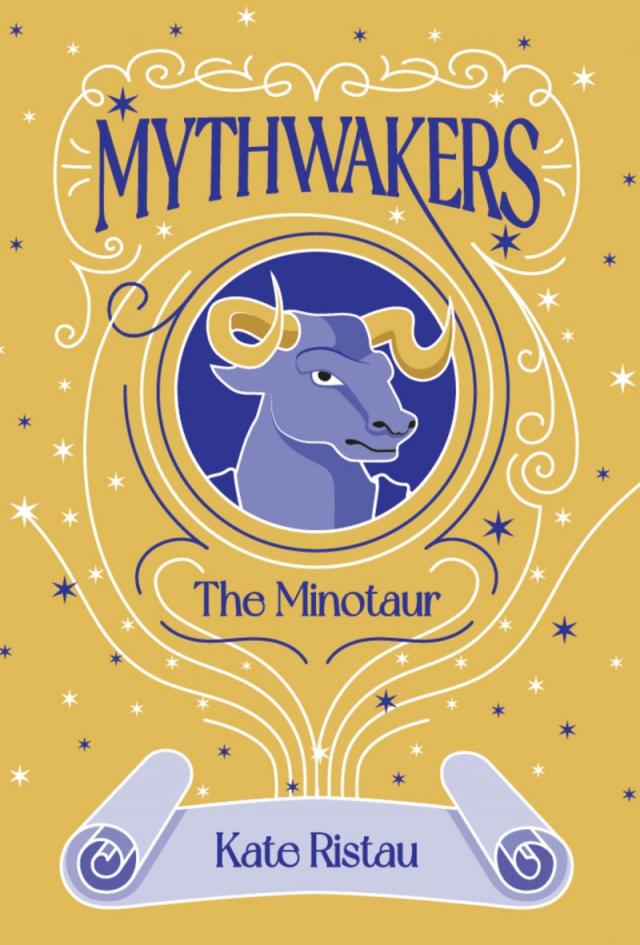


MYTHWAKERS
THE MINOTAUR
KATE RISTAU
Copyright © 2023 by Hope Well Books
All rights reserved.
Cover design: Gigi Little
Interior design: Kate Ristau
First Edition, June 2023
Printed in the United States of America
ISBN: 978-1-7370879-5-3
I. Mythology, Greek—Juvenile Literature. 2. Gods, Greek—Juvenile Literature.
JUVENILE NONFICTION / Social Science / Folklore & Mythology, JNF052030
This book uses Meridian Font.
No part of this book may be reproduced in any form or by any electronic or mechanical means, including information storage and retrieval systems, without written permission from the author, except for the use of brief quotations in a book review.
This book is a work of fiction. Names, characters, places, events and incidents are the products of the author’s imagination or recollections. Any resemblance to actual persons, living or dead, or actual events is purely coincidental or used fictitiously.
For bulk orders, please contact orders@hopewellbooks.com.
The series was made possible by a grant from the Regional Arts and Culture Council and from Kickstarter backers. Keep supporting the arts, my friends! Make the world a better place.
To Mom, for inspiring my love of Greek mythology;
to Rowan, for asking for another story;
to the University of Oregon Folklore Department,
for showing me the myth,
and to Bob, for helping make the magic.
CONTENTS
1. The Minotaur
2. The Setting
3. The Culture
4. The Religion
5. The Characters
6. The Story
7. The Meaning
8. Find Out More
9. Sources
10. Glossary
1
THE MINOTAUR
Hi! My name is Asterion! I am a Minotaur. You may recognize me from such books as Clockbreakers by Kate Ristau, or from old-timey poems and epic stories written by guys like Ovid and Plutarch. Those authors got some things right, but they got more than a few things wrong, and I’m here to set the historical record straight.
1. You are going to see lots of awesome photos of me in Mythwakers. Each one of these photos has a number so you can find more information in the back of the book under sources.
My life is pretty a-maze-ing. Get it?
That joke never gets old, even after all these years. I mean, you could almost get lost in it.
Like a maze.
Moving on, I am so glad you are here. I am a Mythwaker — a legendary character from an ancient myth that has come to define an entire generation. What? You don’t know what a myth is? Dude. You’re going to love this. Pull up a chair, get comfortable, and we’ll explore myths, mazes, and most importantly: me.
Myths
A lot of people use myth to mean a fake story. That’s one meaning of the word myth, but the kind of myths I am talking about are mythology — the foundational narratives, or stories, of a particular culture.
Sorry. I used a lot of big words there. All those centuries trapped in the labyrinth (that endless maze) were SUPER BORING, so I read a lot of scrolls.
Back to myths — just think of them as the important beginning stories of a group of people.
The group of people — or culture — that we will be talking about today is the Greeks, and a little bit about those Minoan dudes, too.
Here’s an important thing for you to know: people argue a lot about my story. Some people think it happened. Other people think it didn’t. Some people think Theseus is a hero, while smart people know that he is a ding-dong.
That’s the thing about myths — they are around for a long time, passed down from one person to the next, so not all the versions are the same. Think about if your best friend told you a story, which you turned around and told your grandma. Would you tell the same exact story your friend told you to your kind, gentle grandmother? Would you keep all the bloody parts or would you clean things up a bit? You would probably make a few changes, right? Most of us do, and that is why myths are never told the same way twice.
Best friend story, now featuring:
Blood and guts!
Nasty villains!
Mean kids!
Burps and farts!
Tacos!
Grandma story, politely exploring:
Talking animals.
Snuggly kittens.
Flowers and smiles.
Five guys named Alfred.
Hard candy.
Stories change depending on who is telling them and who is listening to them. If you’re talking to your best friend, you might be shouting about fiery salsa and guacamole. If you are sweetly sitting beside your grandma, you could be whispering about butterscotch and rainbows.
That’s the thing about myths: the audience matters.
How we remember myths has a lot to do with who was telling the story and who was listening. The stories were constantly changing, but the ones that hung around were the ones that people remembered. They appealed to the culture. They mattered to the listeners. In this way, the audience and the storytellers can change myths for the good, for the bad, and for the tacos.
Folklore
Tacos are good, but they aren’t folklore. Folklore is the stories, art, and culture we create and pass down to one another.
Sometimes, we write our stories in books — like this one! Other times, we share our stories in plays or over dinner. Sometimes we text stories to our friends, or flood them with a never-ending stream of emojis. Folklore is a word we can use to explain all those artistic things we share that are so important, well, we do them over and over again.
Myths are folklore, too — they are stories that have been told and retold again and again. They are shared because they are stories that matter to us and to our community.
All right. That’s enough from me. You think you already know what folklore is, so it is time for a super easy test! Ace it, and you’ll be a legend too.
Which of the examples below are folklore?
Tacos - Riddles - Folk art
Rhyming games - Fairy tales - Mustard
Jokes - A license plate - 2+3
Street art - Folk music - Your phone number
Tacos, Mustard, A license plate, 2+3, and Your phone number are not folklore, but folk music definitely is, and so are all those fairy tales your mom told you. Everything else on that list above is also folklore — artistic things that we do and share with each other a lot.
What about you? What are some things that you create and share with your family and friends? Do you tell stories? Make memes? Sing songs? Tell jokes? Draw comics? What do you love to do?
If you said design punk rock posters, high five! If you said paint pet rocks, high hoof! You rock, and clearly, you make and participate in folklore all the time.
Folklore matters
A myth is a kind of folklore, too, but not everything is folklore. For something to become folklore, it has to really matter to us. The things that last — the things that stick around and that we want to share over and over again with our family and friends — there’s a reason they have that staying power. It’s because they show who we are and what is important to us.
For example, I really like hoof rubs, but did that make it into my myth? No! That’s because me getting awesome hoof rubs didn’t matter as much to the people telling my story: the Greeks.
Enough about folklore! Let’s talk about me.
The Man, the Monster, the Myth
2. William Blake, a poet and printmaker, made me look super intimidating in this illustration. He understood the assignment.
Now, some people say I have the body of a man and the head of a bull. Others say I am half-cow and half-man. I say they are half-rude and I am one-hundred-and-eighty-nine-percent awesome.
I was born this way, with spectacular horns, furry ears, and muscles for days. I also have a nice long tail like any decent Minotaur.
I know. This is where the arguments begin. Some people think I have brown eyes. Some people think they are blue. Some people think smokes pours out of my nostrils — I wish! That would be epic. Except when I was blowing my nose. I would keep lighting all the tissues on fire.
Achoo! AHHHHH!!!
It’s a good thing I don’t have a fire-nose. Or feet. Can you imagine? Some people think I have human feet — like toes and stuff. This is SO TOTALLY NOT TRUE. I don’t have feet! I have hooves — long, sharp, glorious hooves.
Honestly, if the stories had included nice, long hoof rubs, we wouldn’t be having this discussion, would we?
3. Here I am in an engraving by Paul Gustave Louis Christophe Doré. Are those toes? Ewww. Gross.
Ah, well. Not very many people survived the labyrinth (super not my fault), so they don’t really know what I look like, I guess.
What? No! I don’t look like a horse! Neigh, I don’t! Why would you say that? Fine, maybe, when you see super-old drawings of me, sometimes I maybe look just a very tiny bit like a possible horse, but clearly, I am not a horse. I am part bovine, not equine.
4. I am not a horse in this photograph of a shallow bowl with an illustration of Theseus poking me. Super impolite, Theseus.
Sorry, touchy subject. You see, those paintings make me look like I’m a horse because those people don’t know how to draw a bull.
As a side note, if you ever see a statue of me without any han ds, that’s because it’s an old statue and the hands broke off. I have awesome hands. Amazing hands. Unbelievable hands. Monstrous hands!
5. This statue used to be on a fountain. It also used to have hands.
On the other hand (ha!), while I am the Minotaur from all the stories, it’s rude to call someone by what they are, as opposed to their name. I mean, I don’t go around calling you a scrawny human, do I?
Should I?
No? Okay. Then, you can call me by my real name, which is Asterion, as opposed to Manly Minotaur, Bull Guy, or That Cow Man over there.
Asterion means starry. You can find constellations, or groups of stars, that tell my story. Look up into the sky for the Corona Borealis, or the northern crown. It is the crown of my sister, Ariadne. Every time I look up, I am reminded of her long golden hair. She shines so bright.
You don’t need to get out your telescope, though, and be all space-y. I’ll stick around and tell you lots more about me, including why they keep retelling my story, from Hollywood to the heavens and beyond.
2
THE SETTING
Now, when someone sits down to tell you a story, they usually begin with the setting — the time and place of the story. Some stories take place in forests, while others are set in schools or on playgrounds. I have even read a story that took place in an intergalactic, cosmic restroom (you should hear the sound of those interstellar flushes).
There weren’t that many fancy toilets back in the time of my story. In fact, most of us didn’t even have running water, more or less automatic hand dryers. Seriously, we are talking super ancient history, way back before your mom was alive and even before the time of your Great Aunt Melda. Several millennia - thousands of years.
Both time and place matter to the setting when you are telling a story, so we are going to dive into both.
The thing is, while you might think my story takes place in Ancient Greece, that’s not exactly true.
Crete
My life, and my story, began on an island called Crete (Kreet), in the city of Knossos (like Nah, sis). Let me show you around the wonderful island that I call my home.
6. The beautiful island of Crete — my Mediterranean home.
Crete is a large island in the Mediterranean Sea, just off the coast of Greece. It’s sunny and warm in the north most of the year, and a little bit cooler in the south. If you’re planning a visit, stop by, say hi, and I’ll be your tour guide! Make sure you come sometime between July through September, when the ocean is warm and the Loukoumades (Loo-koo-ma-daze) are hot. What? You’ve never had loukoumades? Now you have to come visit. It’s the most delicious fried dough covered in ice cream, nuts, and a drizzle of honey.
I always order my loukoumades with extra honey, so they are sweet as ambrosia on a summer afternoon. Let’s practice out loud so you’re ready to place your order.
Say it loud and proud aloud with me: Loo-koo-MA-daze. Loo-koo-MA-daze. Loo-koo-MA-daze. Loo-koo-MA-daze! Nicely done. Order up! Sink your teeth into those delicious delicacies.
From the Mountains to the Sea
Once you’re done eating, there are mountains to climb, oceans to swim, and even a desert to explore (though I would prefer to explore dessert again).
7. A journey to my island home takes you over high mountains and back down again to the sea.
Pack your bag, and let’s start our journey! You’re going to love Crete. While the island is 160 miles long, it’s only about seven and a half miles wide. That means if you brought a good pair of sandals, you could easily walk from one side to the other in a day.
Well, you’d have to be in really good shape to hike from Knossos to Gortyna (Vort-een-a). There will be more than a few mountains in your way. Crete is a mountainous island, including three main mountain ranges:
The Idi Range
The White Mountains
The Dikti Mountains
Sea to Shinier Sea
But as you pack for the mountains, don’t forget your swimsuit. Crete is known for its sandy beaches and rocky shores. In fact, you can sun your hooves on pink sand beaches. The sand crystals shine in the morning sun. Spend a day in the warm lagoon of Elafonisi (Hey-la-phone-ee-see) Beach before you pack up for Mount Pachnes in the White Mountains. Pachnes is a desert mountain with a barren landscape. It will be your first mountain trek as you head across Crete.
Highlanders know their way around the mountains in Crete. But if you are a lowlander, and you miss one of the well-worn paths through the valleys, you could end up on top of a plateau, having to hike miles out of your way to get to the other beach. It is always a good idea to carry a map in Crete. I am going to share a few maps in the back of the book if you want to know more about my wonderful island home. Just check out the Find Out More section.
The Minoans
My culture (my group of peeps) is not the Greeks, even though my story is in every Greek Mythology book you will ever read. I am just that a-maze-ing. In reality, though, I’m not Greek (they’re the audience for my story, remember?). I am from the Minoan Culture.
Wait a minute…Minoan? Does that sound familiar to you? Yes! That’s right! I’m the mino-taur.
Minotaur means “the bull of Minos” in Ancient Greek. Minos was the King of Crete (nasty dude. We’ll talk about him later). I can’t believe I was named after him. Really, you should call me Asterion. That’s way more polite than naming me after the guy that trapped me in that infinitely boring, interminably endless, utterly unending labyrinth.
More about him later. Or not. It’s my story, and just thinking about him is making me grumpy.
Time for some more Loo-koo-MA-daze! Honey. Nuts. Delicious ice cream. Maybe even a sprinkle of cinnamon to spice things up a bit. Yum. I’m feeling better already.
Fragments in time
You know, I’m an old dude. Not as old as Zeus, but the original Asteria, the starry Titaness that I was named after, gave birth to Hecate, the goddess of witchcraft and magic (or maybe she didn’t). Asteria’s father was either Perses or Zeus (or maybe they weren’t). Historians are still trying to figure that one out, just like they are debating my story (always arguing!). When stories are around so long, there tend to be a few disagreements along the way (totally!). Luckily, we have real, physical evidence to help figure out the story of what happened to me (and we can stop with the parentheses).
Archaeologists have been digging up and searching for evidence of ancient civilizations like mine — the Minoan Civilization — for hundreds of years. In the 21st Century, they use their shovels, brushes and spades to uncover the stories of who we are and what happened to us. In this way, the past is not forgotten. It is just another story waiting to be told.
Evidence
The first evidence you can find of me is around the seventh century BCE — that’s negative 700. Around that time, the Chinese had just invented printing. Since the Internet wasn’t available back then, archaeologists nowadays search beneath the rocks and ruins of Crete. They look for the everyday tools and items we used so they can understand our story. They dig though the rubble and remains of our towns and cities to find out who we were and what mattered to us.
Modern understanding about the Minoans is based on fragments and pieces. Archaeologists are still trying to understand the larger picture. They have found lots of amphoras — fancy, decorated storage containers. If I had one, I’d fill mine with Loo-koo-MA-daze. Anyways, one amphora shows Theseus and I…having a really good conversation about swords.