The dead dont mind, p.1
The Dead Don't Mind, page 1
part #1 of A Mind Games Novel Series
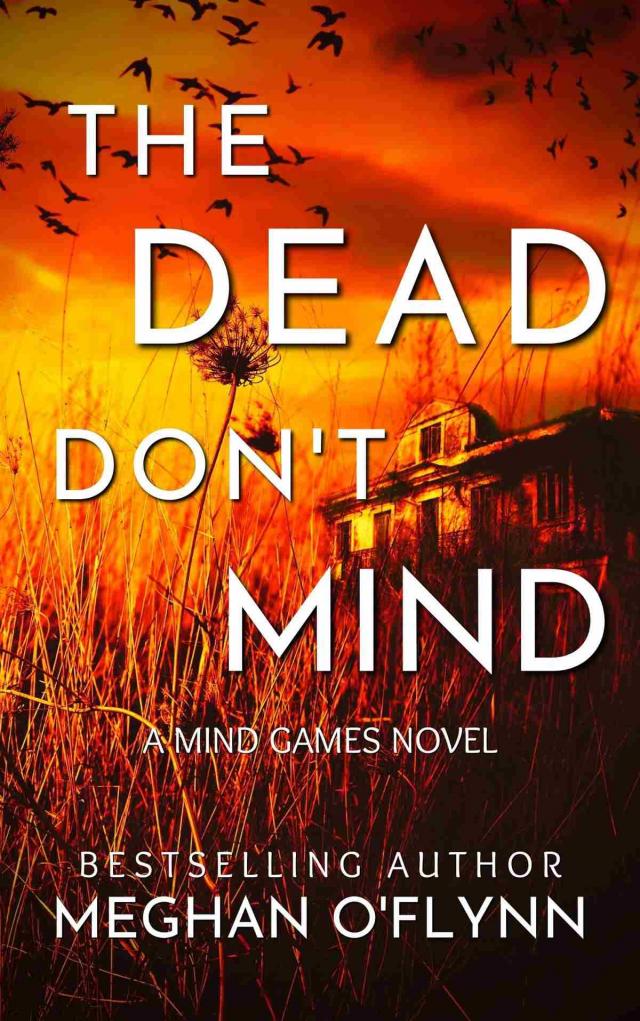


The Dead Don’t Mind
A Mind Games Novel
Meghan O’Flynn
Contents
FREE STUFF!
Chapter 1
Chapter 2
Chapter 3
Chapter 4
Chapter 5
Chapter 6
Chapter 7
Chapter 8
Chapter 9
Chapter 10
Chapter 11
Chapter 12
Chapter 13
Chapter 14
Chapter 15
Chapter 16
Chapter 17
Chapter 18
Chapter 19
Chapter 20
Chapter 21
Chapter 22
Chapter 23
Chapter 24
Chapter 25
Chapter 26
Chapter 27
Chapter 28
Chapter 29
Chapter 30
Chapter 31
Chapter 32
Chapter 33
Chapter 34
THE DEAD DON’T LIE
FREE READER BONUSES!
DEADLY WORDS
CONVICTION
THE FLOOD
Praise for Meghan O’Flynn
Also by Meghan O’Flynn
About the Author
THE DEAD DON’T MIND
Copyright 2022
This is a work of fiction. Names, characters, businesses, places, events, and incidents are either the products of the author’s imagination or used fictitiously. Any resemblance to actual persons, living or dead, or actual events is purely coincidental. Opinions expressed are those of the sometimes screwed-up characters and do not necessarily reflect those of the author.
No part of this book may be reproduced, stored in a retrieval system, scanned, transmitted, or distributed in any form or by any means electronic, mechanical, photocopied, recorded, or otherwise without written consent of the author. If the serial killers in this series had a hit list, book pirates would be right at the top.
All rights reserved, including the right to write into existence—and subsequently kill off—book-stealing copyright infringers.
Distributed by Pygmalion Publishing, LLC
ISBN (electronic): 978-1-947748-40-8
For my brother Tommy
who once carved “Brian was here” in a dresser and snickered when our youngest brother got grounded.
You, sir, are a legend. Also, a bit of a punk.
I love you for both.
Chapter
One
Reid
Detective Reid Hanlon had never been one for flamboyance, though he did have a penchant for the dramatic. Not in word or deed, but in the little pops of color he immersed himself in, the flair that made up a daily existence. His home was decorated in soft mossy grays, but his art was an eclectic mix of vibrant yellows and milky whites and deepest cerulean. His suit today was tailored, gray—not bad-looking at thirty-nine, if he did say so himself—accented by a brilliant purple tie. Bright, almost theatrical.
But the room in which he stood… the florid vividness here was too much. The scene cut deeply, cruelly, despite his twenty years on the force. If he ever found himself numb to the horrors of the job, that would be a sign that he should quit. So when Reid’s jaw clenched, he welcomed it as a manifestation of his still-kicking humanity and leaned into the revulsion. Breathed in the copper. Let the distress seep into his bones.
It wasn’t that the house itself was odd. It was hard to make a cookie-cutter middle-class abode strange without triggering a citation from the HOA. Average-sized rooms, coffee tables hewn in richly stained mahogany. The walls were builder’s grade beige, plenty of opportunity to spice things up with a painting or three, the canvases changeable with mood or season. There were no paintings here now, but the plaster did not lack color. Blood splashed the walls like exuberant child’s art, patterns and swirls that would make perfect sense to the forensic analysts who would soon arrive to dissect the angles of penetration and the resulting spray pattern.
It was often small things that made the difference for the analysts—a tiny dot on a far wall or the level of shine on a congealing puddle. The freshness of the scene should help. Lucky, that. He might not be here at all had it not been for the tiny smudge of claret on the inside of the window glass.
“I was on my bike when I saw the… the… the blood,” the child had said. Ten years old, swimming in an oversized sweatshirt that matched his giant blue eyes, his freckled cheeks damp with tears.
“You have good instincts, Mr. Kole Bishop,” Reid had said. “Sharp like a hawk.” They liked phrases like that here in Fernborn, Indiana—it softened the blow, made one imagine the flight of the hawk instead of the wriggling death clutched in its talons. The child had blinked and offered a trembling smile, but the glassy terror that had shone in little Kole’s gaze had made Reid’s heart hurt.
Reid dragged his attention from the window. So many angles to analyze. So many penetrations.
So much blood.
Reid knelt beside the man of the house. Ted Darren lay prone with the back of his head angled against the couch leg, his neck twisted oddly. Not obviously broken, but snapping the man’s neck would have been overkill. The couch was soaked in crimson, pools of it glittering and wet in the light from the floor-to-ceiling windows. Deep wounds bisected his abdomen and chest. Blood pooled beneath his legs; the killer had hacked at the tendons behind his knees and ankles, presumably to ensure that he couldn’t run. More lacerations gouged chunks of muscle from his forearms, exposing the bones. Defensive wounds. Darren had seen the weapon coming. Perhaps an ax from the way the tissue folded inward below his jaw—a fatal blow to the jugular.
Who was he kidding? He knew it was an ax. He just didn’t want it to be an ax, because that meant it had happened again, just like it had happened two districts over. The fact that he even knew about that case was a fluke; Detective Tengreddy in Point Harris had called him just last week for insights. What were the odds? Did the killer know Reid had been contacted? Perhaps striking here wasn’t a coincidence after all—
“Detective Hanlon? Forensics is here.”
Reid squinted at the body. “Not yet,” he said to the dead man. “Not yet.” He didn’t need to look at the flatfoot in the doorway, probably still pale the way he’d been when Reid arrived, his watery brown eyes darting everywhere except the corpse.
“But—” Officer Marshall began.
“Please,” Reid said, pushing himself to his feet. “I’ll let them in as soon as I’m done walking through.” He needed to see the house as it had been before. He wanted to see it as the killer would have, surrounded by silence as acute as flensing wounds. Surrounded only by the victims.
Marshall stared at him for an extra heartbeat, his eyes beseeching, or maybe just anxious, then backed out. Reid waited until the door clicked shut, then turned for the stairway, the railing honed in a dark wood that matched the coffee tables. Teddy Darren, or perhaps his wife, had a fine eye for detail. He kept his hands in his pockets as he made his way to the second floor, elbows tucked in so as not to brush the walls or the rail. Blood on the stairs—strange for this perp. But he could already hear the rushing water, part of the killer’s trademark.
The water was louder at the top of the stairs and louder still as he approached the rooms. Reid edged through the already open master bedroom door.
Diane Darren—quite the unfortunate bit of alliteration she’d married into—was still tucked under the covers in the master bedroom, but he could see her… or parts of her. Her cloudy eyes were wide to the ceiling, mouth gaping as if shocked, sandy curls cascading limply over the pillow. She’d died quickly from the yawning chasm beneath her jawline, dissected muscle and severed windpipe. Nearly instant death, which was a minor consolation prize, like coming in first in a shit-eating contest.
He stepped nearer, squinting—his mouth tasted like pennies. No severe injuries to the backs of the arms; no time for defensive wounds. But the killer had hacked at her anyway, slicing through the sheets and the fascia that covered her abdomen. The intruder had started his reign of terror up here—no way Diane had slept through the brawl in the living room. The commotion upstairs had probably woken Ted, who’d fallen asleep on the couch. Did the killer know he was walking into a divided sleeping situation? The killer had not left blood on the stairs at any of his past crimes. The deviation screamed “unplanned.”
Reid could see the case notes from the last murder in his head: Injuries made in a downward trajectory, multiple slashing wounds with a low force profile. From the angle here, the killer had almost certainly been crouched beside the bed or kneeling as if in prayer—that was consistent with his past crimes, as was his efficiency. He was always fast, dispatching each victim and moving on before the other occupants had time to react.
But though Diane had died quickly, Ted had not. Downstairs, the killer had made shallower cuts, not using his full strength. Yet Reid was quite sure he hadn’t lost his nerve. He had incapacitated the man first, only later made sure that Ted was dead. Unlike his other crimes, he hadn’t wanted that killing to be quick. He had hated that it was quick.
What was different about Teddy?
Reid was still considering this as he made his way into the hallway. The rushing water was louder here, yelling for his attention, trying to drag him into the bathroom on his right. But the bathroom was always the killer’s last stop.
He took a breath and imagined the upper floor was silent—the water would not have been running when the killer first strode down this hallway. Perhaps he’d have heard the whimper of a wakening child. Perhaps the creaks and groans of his own footsteps. From the fine dots along the baseboard, the ticking drip of Diane’s blood off his blade.
The imagined drip, drip, drip from the ax grew louder; the water faded in his ears. The room to his left—the boy’s—was empty, as he’d been told it would be. Reid paused just outside the door of the last room on the right, steeled himself, and stepped over the threshold.
The bubble-gum pink walls were studded with posters of horses and colored-pencil drawings of the same. The child lay on the bed beneath an oversized photograph of her on a white steed. If the girl had been a brunette, he could almost have imagined that she was asleep, but as it was, her white-blonde hair was bathed in the dramatics of extinction, dark with blood—one hard blow to the back of her neck. But, like her mother, she didn’t suffer. Her left arm was still wrapped around a stuffed unicorn, the horn specked with congealing crimson.
His stomach clenched. That unicorn. Her little fingers wrapped so carefully around the horn. It made Lily Darren look alive, and she felt alive to him, as if her essence were still here. Downstairs, he had felt only the energy of life passed, the muted, heady silence that came with dead things. But here in this room, he almost believed the child might suddenly sit up and look at him. Maybe beg him to save her.
The hairs on the back of his neck prickled, an uncomfortable but insistent tingle that spiked into needles of panic with a sudden flash of movement in his peripheral. I’m not alone.
Reid whirled, hand on the butt of his gun. And straightened. His own face stared back at him from the full-length mirror that hung on the half-open bathroom door, a second entrance to the killer’s final destination. Waxy and pale—he did not look well.
His shoulders relaxed. A trick of the mind; because he wanted the child to be alive, perhaps. Or maybe it was because the incessant whoosh of rushing water almost sounded like breath. It was also possible that Marshall had allowed the forensics team to enter, and he’d missed it because of the running water and his focus on blotting out the noises in the home. But he did not hear the chatter of instruments or voices, just the pressured hiss of the bathtub. Although…
He frowned. The floor was dry; the hallway had been as well. By the time police had arrived at the last crime scene, a waterfall had been cascading down the stairs. The scene before that had featured soggy carpet. Had the killer forgotten to plug the tub?
Unplanned. Definitely unplanned. What was he missing?
Reid stepped nearer to the bathroom, his shoulders squared—
Clink!
He froze. Reid might have imagined that this, too, was a trick of the mind, but then the sound came again. Clink-clink! Bright and fast and decidedly real.
He drew his weapon. “Police!”
The clinking stopped. He stilled, listening, weapon aimed at the half-open door. There shouldn’t be anyone else here. The youngest boy was at camp, according to the neighbors, and everyone else was accounted for—dead, but present.
“Come out with your hands up!” He didn’t believe he was talking to the killer. Probably an animal. Did the children have a cat? But he was not going to risk an ax to the head just because he believed it unlikely. Better cops than him had died for less egregious errors.
He watched the bathroom door. No footsteps approached the other side; he saw no shadow beneath. He edged to the side of the jamb and toed the door the rest of the way open.
Reid’s heart shuddered to a stop. He lowered his weapon.
The bathroom was simple enough, more beige walls and white furnishings, more mahogany cabinetry. The bathtub faucet was running, the drain open—the tub was empty and clean. But that was where the normalcy ended.
A blond-haired boy sat on the closed toilet lid, toes curled underneath him, arms wrapped around his knees. His fingers and pants were bathed in ruby, nails coated in thick, curdled-looking red. A tiny toy car sat in a smeared puddle near the base of the toilet. He held an ax clutched in his fists near his knees, the sharp edge still dripping, the handle dark with blood.
Chapter
Two
Doctor Maggie Connolly’s office vibrated with the nervous energy of a Pomeranian going to see the vet about his balls.
J.D. blinked. “I really don’t like spiders.” The faded teardrop tattoo at the corner of her patient’s eye crinkled, like he was holding real emotion in the inked drop. Her work with the prisons was a job she inherited from her father, but this guy was mostly a marshmallow… if you ignored his controversial twenties. At least, that’s what the parole board had decided after her assessment. Maybe not the marshmallow part, exactly, but life would be more fun if all psychological states were described using dessert.
“That’s fair,” she said, adjusting her reading glasses on the bridge of her nose—very librarian meets barn owl. They went well with her dork-chic corduroys. “We can hold our sessions in the spare office, or I can refer you to another psychologist. My partner is excellent.” Owen would not appreciate her referring parolees his way; she’d referred Tristan Simms six months prior, and Simms had yet to make an appointment.
That hadn’t stopped Tristan from calling Maggie herself, but no doctor should treat a man they had less-than-professional dreams about. It might have been sexual attraction or merely a response to the highly stressful situation they’d found themselves in last year. Then, Tristan, her patient, had been the top suspect in a series of homicides.
She pushed her curly red hair off her forehead; the back of her neck was damp. Avoidance was the best course of action when it came to Tristan Simms. She was sure. Mostly.
J.D. cut his eyes at the tank behind her—at Fluffy. J.D. shook his head. “We can keep meeting here,” he said.
“A tough guy, eh?” It was a terrible New Jersey accent, but you didn’t get to be a first-class geek without taking some risks.
His shoulders stiffened; his chest puffed out. “Tougher than a bug.”
“Arachnid.” Right, that’s the information he came here for. She cleared her throat. “But perhaps we could explore what toughness means to you. Vulnerability is often a more accurate sign of strength.” Unlike, say, killing someone in a bar fight as J.D. had.
He frowned. It made the teardrop on his cheek lengthen in the early morning light. Tattoos didn’t age well. If she ever got a teardrop, she’d ink it on her shoulder where it would spread to look like a cancerous mole. At least she could use that to freak out her friends.
The session ate through the next hour, and by the time she walked J.D. to the front door and collapsed back into her chair, the sun had moved beyond the lower pane of the window to cast sharp blades of springtime warmth against the floor. It had been six months since her house burned to the ground, and she still occasionally felt the blistering heat of that night when the sun hit her skin. At least she’d fared better than the body in the garage.
It would have been hard to fare worse.
She dragged her gaze from the sun-soaked hardwood. She should call Reid. The detective, and Tristan’s half brother, had taken to picking her brain about his cases. But six months of history wouldn’t help once he realized she’d gotten J.D. out on parole. He was the one who’d put J.D. behind bars.
She hadn’t done anything wrong, of course, but…
Maggie sighed and reached for her cell, but she hadn’t even gotten it out of the drawer when it rang. Speak of the devil.