Authors choice v1 0, p.1
Authors Choice (v1.0), page 1


07-02-2023 converted from a scan
A GAME PEOPLE MAY PLAY—SOMEDAY from Theodore R. Cogswell’s “Consumer’s Report”:
Alan went up to the referee’s tank and threw a quick salute at the vision slit.
“Wetzel substituting for Mitchell.”
“Check,” said the bored voice of the official inside. “Fight clean and fight hard and may the best team win.” The formula came mechanically. Neither the referee nor anybody else had any doubt that the best team had won.
Alan was halfway to the hastily dug trenches that marked his team’s position when a mortar shell exploded forty feet away and knocked him off his feet. There was a sudden outraged blast from the enemy’s siren, and then the enemy captain bobbed out of his foxhole.
“Sorry, sir,” he yelled. “One of my mortar crews was sighting in and accidentally let off a round.”
The referee wasn’t impressed.
“That’ll cost you exactly twenty yards,” he said.
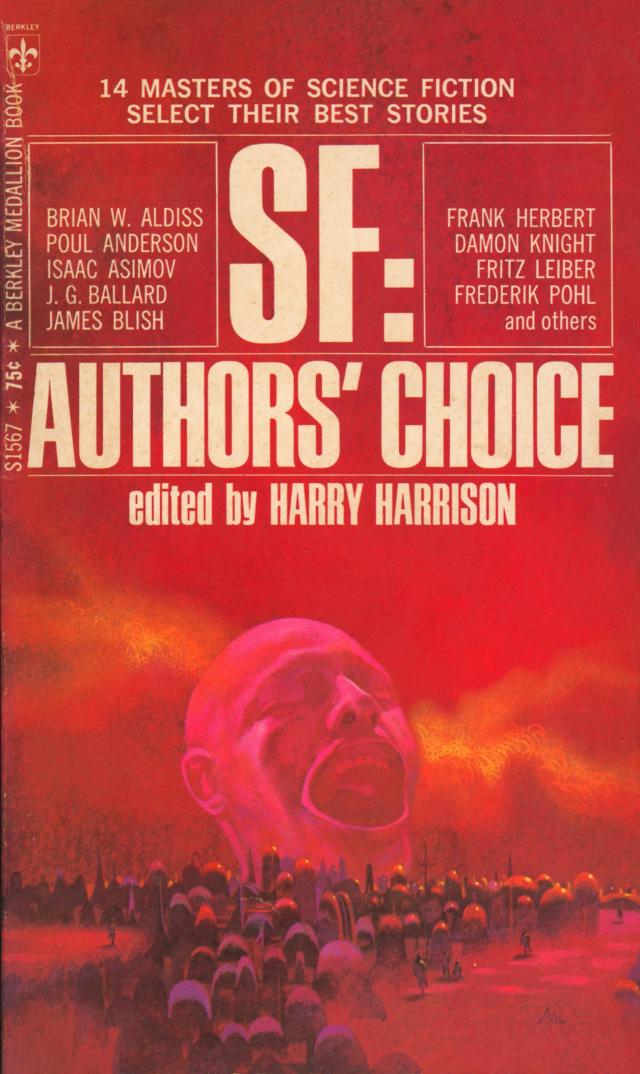
SF:
AUTHORS’
CHOICE
edited by HARRY HARRISON
Copyright © 1968 by Harry Harrison
All rights reserved
Published by arrangement with the author’s agent
BERKLEY MEDALLION EDITION, JUNE, 1968
ACKNOWLEDGMENTS
“Judas Danced” by Brian W. Aldiss. Copyright © 1958 by Ballantine Books, Inc. Reprinted by permission of the author.
“The Last of the Deliverers” by Poul Anderson. Copyright © 1958 by Mercury Press, Inc. Reprinted by permission of the author and the author’s agents, Scott Meredith Literary Agency, Inc.
“Founding Father” by Isaac Asimov. Copyright © 1965 by Galaxy Publishing Corporation. Reprinted by permission of the author. “End-Game” by J. G. Ballard. Copyright © 1963 by New Worlds SF. Reprinted by permission of the author.
’Tiger Ride” by James Blish and Damon Knight. Copyright 1948 by Street and Smith Publications, Inc. Reprinted by permission of the authors.
“Consumer’s Report” by Theodore R. Cogswell. Copyright 1955 by Imagination. Reprinted by permission of the author.
“Proposal” by L. Sprague de Camp. Copyright 1952 by Startling Stories. Reprinted by permission of the author.
“Sail On! Sail On!” by Philip Jos6 Farmer. Copyright 1952 by Startling Stories. Reprinted by permission of the author and the author’s agents, Scott Meredith Literary Agency, Inc.
“Missing Link” by Frank Herbert. Copyright © 1959 by Street and Smith Publications, Inc. Reprinted by permission of the author. “Myths My Great-Granddaughter Taught Me” by Fritz Leiber. Copyright © 1963 by Mercury Press, Inc. Reprinted by permission of the author.
“Syndrome Johnny” by Katherine MacLean. Copyright 1951 by Galaxy Publishing Corporation. Reprinted by permission of the author.
“Day Million” by Frederik Pohl. Copyright © 1966, by Rogue Magazine. Reprinted by permission of the author.
“Retaliation” by Mack Reynolds. Copyright © 1965 by Galaxy Publishing Corporation. Reprinted by permission of the author and the author’s agents, Scott Meredith Literary Agency, Inc.
BERKLEY MEDALLION BOOKS are published by
Berkley Publishing Corporation
200 Madison Avenue
New York, N. Y. 10016
BERKLEY MEDALLION BOOKS ® TM 757,375
Printed in the United States of America
For
KINGSLEY AMIS hearty partisan— and stern critic
Contents:-
Introduction
Judas Danced by Brian W. Aldiss
The Last of The Deliverers by Poul Anderson
Founding Father by Isaac Asimov
End-Game by J. G. Ballard
Tiger Ride by James Blish and Damon Knight
Consumer’s Report by Theodore R. Cogswell
Proposal by L. Sprague de Camp
Sail On! Sail On! by Philip José Farmer
Frank Herbert Missing Link by Frank Herbert
Myths My Great-Granddaughter Taught Me by Fritz Leiber
Syndrome Johnny by Katherine MacLean
Day Million by Frederik Pohl
Retaliation by Mack Reynolds
Introduction
Art is a winged word, neither to hold nor to bind, ever ready to fly away with a discussion that would fasten it to its own ground and to the work that bears its name. The homely note of the craft allows no such distractions; it holds you fast to the matter in hand, to the thing that has been made and the manner of its making; nor lets you forget that the whole of the matter is contained within the finished form of the thing, and that the form was fashioned by the craft.
Percy Lubbock
from the preface to
The Craft of Fiction
This volume has been fashioned by the writers whose stories it contains, chosen by them despite the barriers and restrictions I placed in their way. I wanted only stories that they liked, that had not been anthologized before, that they had a particular reason for writing, that were of a certain length—and I still reserved the editorial prerogative of rejection, which I exercised freely. The length of the correspondence, in some cases, exceeds the length of the story. This has resulted in an anthology of representative stories by some of the most able practitioners in the science fiction field, a book that may be read for the fiction alone, but that has an added dimension in that each contributor has added a comment about his own story. I hope you will also experience the sharp pleasure that I felt when, one by one, these idiosyncratic and personal statements arrived.
Though I have been selective in choosing the fiction, I have attempted no restrictions on the comments. All I asked for was some truth about each story, and I received that in abundance. I gave the maximum length for the comment—which naturally some writers instantly violated. I did not state where the comments were to run—so they came both before and after the stories, and in one case both before and after. I hoped for some comment on the craft of science fiction—and received polemics on politics and the finances of writing.
I have enjoyed every word of it. The most exciting part has been the realization that Percy Lubbock’s winged word of art has been brought to ground in these essays on our craft. Art gains a dimension through understanding, and you will find that here. How much more enjoyable “Sail on! Sail On!” is after a plunge into the wonderful possibilities and ramifications of Farmer’s imagined universe. And what interesting strings of speculation we can pick up and follow from “Myths My Great-Granddaughter Taught Me” after seeing from what a maelstrom of myth the author has plucked his material.
I have no favorites; I like them all, for they are all true statements. Cogswell no truer than the others when he tells the editor off for attempting to analyze the craft of science fiction in this manner. Or Aldiss no less revealing in his glimpse into the intimacies of the creative process. I will not go on, for every entry strikes a common note of sincerity.
My only regret is that this volume could not have been longer, and it is physical limitations alone that have prevented the inclusion of many other writers of importance. The thirteen here are all personal friends whose writing and companionship I have always enjoyed. I have tried to select stories that contain their own individualistic contribution to this form of literature, then attempted to subtly goad them into revealing something about the craft that presents their art. They responded with an enthusiasm for which I will always be grateful.
Here are the results.
Harry Harrison
Judas Danced
by Brian W. Aldiss
It was not a fair trial.
You understand I was not inclined to listen properly, but it was not a fair trial. It had a mistrustful and furtive haste about it. Judge, counsel and jury all took care to be as brief and explicit as possible. I said nothing, but I knew why: everyone wanted to get back to the dances.
So it was not very long before the judge stood up and pronounced sentence:
“Alexander Abel Crowe, this court finds you guilty of murdering Parowen Scryban for the second time.”
I could have laughed out loud. I nearly did.
He went on: “You are therefore condemned to suffer death by strangulation for the second time, which sentence will be carried out within the next week.”
Round the court ran a murmur of excitement.
In a way, even I felt satisfied. It had been an unusual case: few are the people who care to risk facing death a second time; the first time you die makes the prospect worse, not better. For just a minute, the court was still, then it cleared with almost indecent haste. In a little while, only I was left there.
I, Alex Abel Crowe—or approximately he—came carefully down out of the prisoner’s box and limped the length of the dusty room to the door. As I went, I looked at my hands. They weren’t trembling.
Nobody bothered to keep a check on me. They knew they could pick me up whenever they were ready to execute sentence. I was unmistakable, and I had nowhere to go. I was the man with the clubfoot who could not dance; nobody could mistake me for anyone else. Only I could do that.
Outside in the dark sunlight that wonderful woman stood waiting for me with her husband, waiting on the court steps. The sight of her began to bring back life and hurt to my veins. I raised my hand to her as my custom was.
“We’ve come to take you home, Alex,” Husband said, stepping toward me.
“I haven’t got a home,” I said, addressing her.
“I meant our home,” he informed me.
“Elucidation accepted,” 1 said. “Take me away, take me away, take me away, Charlemagne. And let me sleep.”
“You need a sleep after all you have been through,” he said. Why, he sounded nearly sympathetic.
Sometimes I called him Charlemagne, sometimes just Charley. Or Cheeps, or Jags, or Jaggers, or anything, as the mood took me. He seemed to forgive me. Perhaps he even liked it—I don’t know. Personal magnetism takes you a long way; it has taken me so far I don’t even have to remember names.
They stopped a passing taxi and we all climbed in. It was a tumbrel, they tell me. You know, French? Circa seventeen-eighty something. Husband sat one side, Wife the other, each holding one of my arms, as if they thought I should get violent. I let them do it, although the idea amused me.
“Hallo, friends!” I said ironically. Sometimes I called them “parents,” or “disciples,” or sometimes “patients.” Anything.
The wonderful woman was crying slightly.
“Look at her!” I said to Husband. “She’s lovely when she cries, that I swear. I could have married her, you know, if I had not been dedicated. Tell him, you wonderful creature, tell him how I turned you down!”
Through her sobbing, she said, “Alex said he had more important things to do than sex.”
“So you’ve got me to thank for Perdita!” I told him. “It was a big sacrifice, but I’m happy to see you happy.” Often now I called her Perdita. It seemed to fit her. He laughed at what I had said, and then we were all laughing. Yes, it was good to be alive; I knew I made them feel good to be alive. They were loyal. I had to give them something—I had no gold and silver.
The tumbrel stopped outside Charley’s place—the Husband Residence, I’d better say. Oh, the things I’ve called that place! Someone should have recorded them all. It was one of those inverted beehive houses: just room for a door and an elevator on the ground floor, but the fifth floor could hold a ballroom. Topply, topply. Up we went to the fifth. There was no sixth floor; had there been, I should have gone up there, the way I felt. I asked for it anyhow, just to see the wonderful woman brighten up. She liked me to joke, even when I wasn’t in a joking mood. I could tell she still loved me so much it hurt her.
“Now for a miracle, ye pampered jades,” I said, stepping forth, clumping into the living roam.
I seized an empty vase from a low shelf and spat into it. Ah, the old cunning was still there! It filled at once with wine, sweet and bloody-looking. I sipped and found it good.
“Go on and taste it, Perdy!” I told her.
Wonderful W. tinned her head sadly away. She would not touch that vase. I could have eaten every single strand of hair on her head, but she seemed unable to see the wine. I really believe she could not see that wine.
“Please don’t go through all that again, Alex,” she implored me wearily. Little faith, you see—the old, old story. (Remind me to tell you a new one I heard the other day.) I put my behind on one chair and my bad foot on another and sulked.
They came and stood by me…not too close.
“Come nearer,” I coaxed, looking up under my eyebrows and pretending to growl at them. “I won’t hurt you. I only murder Parwen Scryban, remember?”
“We’ve got to talk to you about that,” Husband said desperately. I thought he looked as if he had aged.
“I think you look as if you have aged, Perdita,” I said. Often I called him Perdita too; why, man, they sometimes looked so worried you couldn’t tell them apart.
“I cannot live forever, Alex,” he replied. “Now try and concentrate about this killing, will you?”
I waved a hand and tried to belch. At times I can belch like a sinking ship.
“We do all we can to help you, Alex,” he said. I heard him although my eyes were shut; can you do that? “But we can only keep you out of trouble if you cooperate. It’s the dancing that does it; nothing else betrays you like dancing. You’ve got to promise you’ll stay away from it. In fact, we want you to promise that you’ll let us restrain you. To keep you away from the dancing. Something about that dancing…
He was going on and on, and I could still hear him. But other things were happening. That word “dancing” got in the way of all his other words. It started a sort of flutter under my eyelids. I crept my hand out and took the wonderful woman’s hand, so soft and lovely, and listened to that word “dancing” dancing. It brought its own rhythm, bouncing about like an eyeball inside my head. The rhythm grew louder. He was shouting.
I sat up suddenly, opening my eyes.
W. woman was on the floor, very pale.
“You squeezed too hard, boy,” she whispered.
I could see that her little hand was the only red thing she had.
“I’m sorry,” I said. “I really wonder you two don’t throw me out for good!” I couldn’t help it, I just started laughing. I like laughing. I can laugh even when nothing’s funny. Even when I saw their faces, I still kept laughing like mad.
“Stop it!” Husband said. For a moment he looked as if he would have hit me. But I was laughing so much I did not recognize him. It must have done them good to see me enjoying myself; they both needed a fillip, I could tell.
“If you stop laughing, I’ll take you down to the club,” he said, greasily bribing.
I stopped. I always know when to stop. With all humility, that is a great natural gift.
“The club’s the place for me,” I said. “I’ve already got a clubfoot—I’m halfway there!”
I stood up.
“Lead on, my loyal supporters, my liege lords,” I ordered.
“You and I will go alone, Alex,” Husband said. “The wonderful woman will stay here. She really ought to go to bed.”
“What’s in it for her?” I joked. Then I followed him to the elevator. He knows I don’t like staying in any one place for long.
When I got to the club, I knew, I would want to be somewhere else. That’s the worst of having a mission: it makes you terribly restless. Sometimes I am so restless I could die. Ordinary people just don’t know what the word means. I could have married her if I had been ordinary. They call it destiny.
But the club was good.
We walked there. I limped there. I made sure I limped badly.
The club had a timescreen. That, I must admit, was my only interest in the club. I don’t care for women. Or men. Not living women or men. I only enjoy them when they are back in time.
This night—I nearly said “this particular night,” but there was nothing particularly particular about it—the timescreen had only been timed roughly three centuries back into the past At least, I guessed it was twenty-first century stuff by the women’s dresses and a shot of a power station. A large crowd of people were looking in as Perdita Caesar and I entered, so I started to pretend he had never seen one of the wall screens before.
“The tele-eyes which are projected back over history consume a fabulous amount of power every second,” I told him loudly in a voice which suggested I had swallowed a poker. “It makes them very expensive. It means private citizens cannot afford screens and tele-eyes, just as once they could not afford their own private cinemas. This club is fortunately very rich. Its members sleep in gold leaf at nights.”
Several people were glancing round at me already. Caesar was shaking his head and rolling his eyes.
“The tele-eyes cannot get a picture further than twenty-seven centuries back,” I told him, “owing to the limitations of science. Science, as you know, is a system for taking away with one hand while giving with the other.”
He could not answer cleverly. I went on: “It has also proved impossible, due to the aforesaid limitations, to send human beings further back in time than one week. And that costs so much that only governments can do it. As you may have heard, nothing can be sent ahead into time—there’s no future in it!”