

Aristoi, p.1
Aristoi, page 1


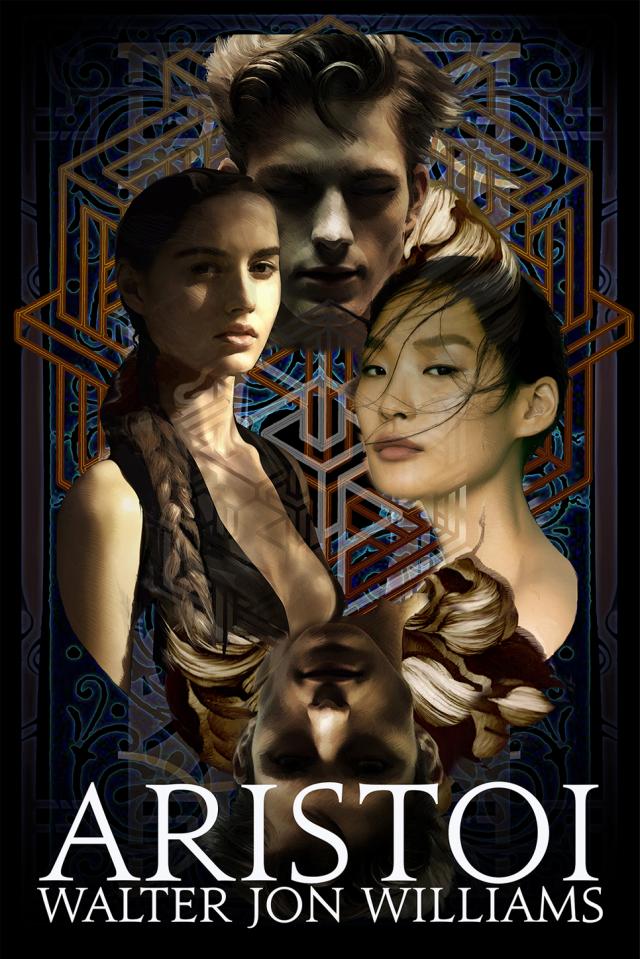
ARISTOI
Walter Jon Williams
With thanks and gratitude to Sage Walker, Rebecca Meluch, William F. Wu, Melinda Snodgrass, Pati Nagle, Sally Gwylan, Pat McGraw, Salomon Montoya, Karen McCue, Mr. Bill Packer, Laura J. Mixon, Judith Tarr.
Special thanks to Kathy Hedges for help in preparing this ebook.
This is a work of fiction. All the characters and events portrayed in this book are fictitious, and any resemblance to real people or events is purely coincidental.
ARISTOI
Copyright (c) 1992, 2012 by Walter Jon Williams
All rights reserved, including the right to reproduce this book, or portions thereof, in any form.
Other Books by Walter Jon Williams
Novels
Hardwired
Knight Moves
Voice of the Whirlwind
Days of Atonement
Aristoi
Metropolitan
City on Fire
Ambassador of Progress
Angel Station
The Rift
Implied Spaces
Quillifer Series
Quillifer!
Quillifer the Knight
Lord Quillifer
Divertimenti (Maijstral)
The Crown Jewels
House of Shards
Rock of Ages
The First Books of the Praxis
(Dread Empire’s Fall)
The Praxis
The Sundering
Conventions of War
Investments
Impersonations
The Second Books of the Praxis
The Accidental War
Fleet Elements
Imperium Restored
Dagmar Shaw Thrillers
This Is Not a Game
Deep State
The Fourth Wall
Diamonds for Tequila
Divertimenti Series (Maijstral)
The Crown Jewels
House of Shards
Rock of Ages
Collections
Facets
Frankensteins and Foreign Devils
The Green Leopard Plague and Other Stories
The Best of Walter Jon Williams
Privateers and Gentlemen (Historical Fiction)
To Glory Arise
The Tern Schooner
Brig of War
The Macedonian
Cat Island
Author’s Note
Parts of the original 1992 edition of Aristoi were formatted in a unique format, broken into two columns, with the action described in the rightmost column, and the character’s internal dialog (conducted by his daimones) on the left. For this electronic edition, I have spent countless hours trying to duplicate this style in the various e-formats available, all with discouraging results. At worst the final product was unreadable; at best it was distracting.
The present edition sacrifices to readability the author’s original intent by condensing the two-column text into a single, readable column. It is to be hoped that advances in e-reader technology may some day permit the text to be viewed easily in its original format.
Note on Pronunciation
Readers are encouraged to pronounce the foreign words any way that appeals to them, but readers who share with the author a touch of pedantry might prefer the following: The accent marks indicate nothing more than the stress over the syllable. Therápontes is accented on the second syllable, skiagénos in the third.
The words taken from Chinese are transcribed in Pinyin, not Wade-Giles, and are therefore pronounced more or less as the English-speaking reader finds them, with only two exceptions: the Zh in “Zhenling” is pronounces like the j in “justice,” and the word qi is pronounced “chee.”
As a final note, I should point out that Aristos and Aristoi have their accent on the first syllable.
ARISTOI
Chapter One
ANIMAL TAMER: Walk in, walk in to my menagerie
Full of life and cruelty.
At Graduation, every five or seven or ten years, the Aristoi celebrated in Persepolis.
For the most part they celebrated themselves.
Persepolis, in the Realized World, was an interesting artifact. It shaded by degrees into “Persepolis,” the real place becoming, with its illusory/electronic deeps and towers, an ever-flexible, ever-unfolding megadimensional dream.
Persepolis, the place, had been reconstructed on its original Persian floor plan, and sat on its reconstructed plain at the meeting of the reconstructed Pulvar and Kor, where it took its place as the (largely symbolic) capital of a reconstructed Earth2. The city was inhabited only a few days each year, when Pan Wengong, the most senior of the Aristoi, convened the Terran Sessions. Behind the City of a Hundred Columns loomed Kuh-e-Rahmat, the Mount of Mercy, its grey flanks a contrast to the bright gold, vermilion, ivory, and turquoise that accentuated the city. To the hewn tombs of Achaemenid kings carved into the side of the mountain were added those of many Aristoi, laid to rest in their capital beside the descendants of Kurush the Great, whose tenuous spirits were presumed to be flattered by the comparison. Atop the mountain itself, surrounded by a grove of cypress, was the gold monument to the lost Captain Yuan, a place of homage and worship.
“Persepolis,” the dream, was a far more interesting place. Most of the people who came here did not do so in the flesh but through the oneirochronon, and the two cities superimposed on one another in ways both intricate and obscure. Earth2’s archons and senators strolled along the corridors, holding conversations with people others could not see. Corridors that dead-ended in reality possessed doors and branches in the oneirochronic world. Some led to palaces, dominions, grottos, and fantasies that did not exist on Earth2, or indeed anywhere, but were instead the special habitats of oneirochronic Aristoi, some of whose bodies were long in the grave. In these palaces the inhabitants danced and discussed and feasted and loved— there had long been competition among them to design the most dazzling sensual experiences for one another, delightful unrealities more striking, more “real,” than anything experienced in the flesh.
To Persepolis, the dream, came Gabriel. Demons buzzed insistently in his head, but he kept them on a tight rein.
For Persepolis was a place where demons, as well as dreams, were shared.
*
A few days before his arrival in Persepolis, in a shimmering predawn on Illyricum, Gabriel glided through his gardens like a ghost. Perfume rose at his footsteps, lingered in the still air. Sometimes he wanted simply to be himself: his daimones were asleep or busy with their own projects, and all was peaceful, as perfect as the plans of this garden he had once built in the oneirochronon before consummating it in the Realized World.
Rectangles cut the solemn sky as solar panels in the Residence, the Red Lacquer Gallery, and the Autumn Pavilion slid in silence from concealment and deployed to catch the first rays of dawn on their surfaces, layers of matte-black photo-reactive polymer woven with pure gold. The rising sun turned the gold grids to scarlet flame.
An English bull terrier, Manfred, trotted silently at Gabriel’s heels, absorbing in its own fashion the dawn, the garden, the perfume. The terrier had implanted as a nurse and in another few moments would be assisting Gabriel with some minor surgery.
Gabriel climbed the cloudy opal steps of the Autumn Pavilion and stepped into the interior. He seated himself, facing the entrance, on a bench of a black soft-crystal ceramic that reacted to his body heat, yielded and conformed to his shape. Manfred curled up at his feet and yawned. An early bird gave a tentative call.
“Open,” Gabriel said.
Silent shutters folded themselves away, inviting the mother-of-pearl dawn. Flower perfume crept into the still building. The Autumn Pavilion featured rooms designed by each of Gabriel’s primary daimones, and this room was Horus’s contribution: logically eight-sided, the walls covered with Illyrian Workshop ceramic tiles in aspen-yellow and maple-crimson, each featuring a hand-painted harvest scene from pre-industrial times. Benevolent Demeter gazed down on all this activity from a ceiling fresco set amid a classic rococo plaster frieze. Tables set beneath the windows were unassuming wrought-iron. Antique vases held dried flowers to the nonexistent wind.
There was a self-portrait in oils by Horus on one wall, Gabriel’s pointed face unusually grave and balanced beneath the curling mass of copper hair, brows a little knit but on the whole approving of what he saw. The startling blue of the eyes was a little deemphasized, the wise epicanthal folds pronounced.
Gabriel watched, absorbing the sight, as the spinning globe dropped morning into the garden. Photons’ touch caused palati plants to fire pollen from their tube-shaped flowers. Floating particles glowed in the light of the rising sun.
Dawn, in her golden sandals, Gabriel thought, after Sappho. Whatever thought came next drifted away with the palati pollen before he could catch it.
He was going to impregnate the Black-Eyed Ghost, his lover. He thought for a moment about that, about gametes floating like pollen, about bits of himself set adrift in the universe.
His various selves seemed at peace with the notion.
The dog yawned again. The light, as the sun rose, turned bluer, more precise. Reality took on a hard, photographic edge, qualities for which thousands of artists came to this system, this planet. Illyricum, the World of Clear Light.
Gabriel’s world. He had built it, designed its effects, contributed to its architecture. Issued decrees to its population, at least when he felt like it, which wasn’t often. He had, in fact, o wned the whole thing, till he’d given most of it away.
Illyricum was one of several worlds that Gabriel had designed.
He liked to think he hadn’t made too many mistakes with any of them.
*
For the opening night’s reception in Persepolis Gabriel dressed his skiagénos in a forest green jacket covered with gold brocade, tight breeches of a lighter green with Hungarian-style laces on the thigh-tops, black reflective Hessian boots with gold tassels. The cravat was pinned with a diamond, gemstones ornamented the fingers, the hair was drawn back with diamond-and-enamel clips. Atop his head Gabriel put a soft bonnet with a diamond pin and dashing feather. He worked some long moments getting his scent precisely the way he wanted it, just the proper combination, a hint of spice and intrigue.
The finery was not purely ornamental. None of it existed in the Realized World— the outfit was purely oneirochronic— but it all served as advertising for Gabriel’s programming skills. The stiff touch of the brocade had to be plausibly different from the soft feel of the hat, the tickle of the feather, the plaint mass of copper hair, the warm press of Gabriel’s flesh. The reflective look of the polished boots was different from the hard, depthless glitter of the stones on his fingers, the cheerful liquid highlights in his eyes, the soft weave of the jacket and the complex patterned loops of the glowing gold brocade. The tassels on the boots were reflected in the boots themselves and cast complex shadows as they danced.
It all had to be, not simply real, but finer, more real, than reality itself. True reality was often overlooked in its more exact details, and Gabriel did not want to be overlooked. The careful programming put into Gabriel’s appearance, the slight exaggeration built into its visual and tactile dimensions, was meant to give it an impact somewhat greater than the real— the Realized— thing.
For the occasion Gabriel flew up to where his yacht, the Pyrrho, waited. He restrained himself with tethers in a null-gee room and had his face constantly scanned by microwatt laser so that his real expression could be transmitted to the skiagénos and that its facial expressions would be Gabriel’s own. In zero-gee he could move his real body in synch with the skiagénos in order to enhance his illusion and the conviction of his performance.
The most important people in the Logarchy would be watching. He didn’t intend to disappoint them.
Gabriel entered the oneirochronon and told his reno to establish a tachline link to Earth2. He materialized his skiagénos in the virtual apartment he’d built in the dream Persepolis and looked about him. The furniture, the hangings, all were as he remembered. Shadow-servants in the shapes of fairy-tale bipedal animals moved toward him, triggered by his appearance. An oneirochronic quintet were frozen in one corner, awaiting only the command to play.
Gabriel inspected the servants’ livery and made certain it suited their somewhat inhuman shapes. They hadn’t been animals at the last Graduation— their shapes (orange tabby, striped Olivian tetrapus, bright-eyed otter) were a more recent whimsy. He made certain the animals’ fur possessed the proper warmth, softness, and resilience— there was even a slight crackle of static as he stroked them— then passed on to the quintet. He triggered their action, gauged and adjusted the tone. The interpretation had been borrowed from his own Residence chamber musicians. The musicians were dressed in 18th Century Viennese court dress, white wigs and all.
Everything seemed ready. Gabriel froze the action and then left the suite through carven jade doors.
The doors led to an underground corridor in the palace of Darius I that existed both in reality and in the oneirochonic Persepolis. The first person Gabriel saw he recognized: Therápon Protarchon Akwasibo, who had served under Gabriel decades before, when Gabriel was a very new, very young Aristos.
As of tomorrow, Akwasibo would be made an Ariste herself.
Her lanky body was clothed in a dress of diamond-shaped mirrors. Invisible spotlights seemed to bounce off the reflective surfaces, casting gold reflections on the walls. Her Ethiopian eyes were rimmed with kohl; her long neck was supple as that of Nefertiti (and scarcely exaggerated at all, as Gabriel remembered). There was another diamond-shaped mirror set flat in her forehead, and two more dangled from her ears.
“Greetings, Gabriel Aristos.” Assuming a Posture of Formal Regard.
Gabriel raised a hand. “Hail, newly-immortal.”
She smiled. Gabriel embraced her and kissed her hello. Her dream-breath smelled of oranges, and her dream-lips seemed to vibrate slightly, a not unpleasant effect.
“Are you on your way to the reception?” Gabriel asked.
“Point of fact, I was on my way to see you. The city’s reno told me you’d arrived and I came right over.”
Gabriel lifted an eyebrow. “Is your business that urgent?”
“Depends on your definition of urgent. We can walk to the reception if you like.”
“Take my arm.”
“A pleasure.”
They strolled up the corridor. The wall frescos were a translucent sea blue, and dolphins, gold and white and deep azure, frolicked thereon. The warm Persian wind brought the fresh scent of cypress. It was autumn here, and somehow that sense had been translated into the oneirochronon. Good programmers, here.
Pan Wengong employed only the best.
“I wanted simply to thank you,” Akwasibo said. “I think you were the aristos who taught me the most.”
“I was dreadfully experienced. Under thirty, for heaven’s sake, and I wasn’t that much older than you.”
“You taught me while you were teaching yourself. Of course it took me over forty years before I could really put it all in practice.”
“But you’ll make many fewer mistakes than I.”
“The only thing I can say with confidence is that they probably won’t be the same mistakes.”
The sound of wind chimes floated on the wind, and then the unreal sound of a reed flute. Gabriel and Akwasibo turned toward the Apadana, the great hall of Darius I.
Over the dream-city drifted a dream-moon, half-full in a mild blue sky. The real Luna after which it was modeled had long been more Realized than most places— its interior had now been transformed, molecule by molecule, into a huge data store, one of many that made up the Hyperlogos, the universal data pool. Save for that under the Seal of the Aristoi, almost every bit and byte of it was accessible, something that contributed more to peace in the Logarchy than all the social engineers in history.
“I’m a bit nervous,” Akwasibo confessed. “What sort of thing goes on at these receptions?”
“Pleasure. Display. Rivalry. Intrigue.” Gabriel smiled. “Everything that makes life worth living.”
*
The palati pollen floated through Illyricum’s breathless dawn air. Gabriel rose from the bench, and Manfred picked himself up, stretched, yawned yet again, and followed Gabriel from the pavilion. Fading motes of dawn danced in Gabriel’s path as he returned to the main building of the Residence.
As he walked past the Shadow Cloister he heard a mumbled, weary chant, and remembered that he’d received a report that the Therápon Dekarchon Yaritomo, the demiourgós in charge of tax assessment for one of Illyricum’s provinces, had announced he would ere long attempt the ritual of Kavandi. Gabriel told Manfred to wait for him and stepped quietly through a turquoise-encrusted archway to watch the ordeal.
Yaritomo was a stocky man not quite seventeen, a recent graduate of Lincoln College at Illyricum University. He had performed well at the duties that Gabriel had set him in order to acquaint him with the basics of civil administration. Reports from the Psychological Department indicated that Yaritomo’s personality had shown a tendency to avoid fragmentation by milder techniques, and Kavandi was his own choice.
Yaritomo was naked beneath the metal frame he had strapped to his body. The frame held over fifty stainless-steel spears, all surgically sharp, all pointed inward to his skin.






